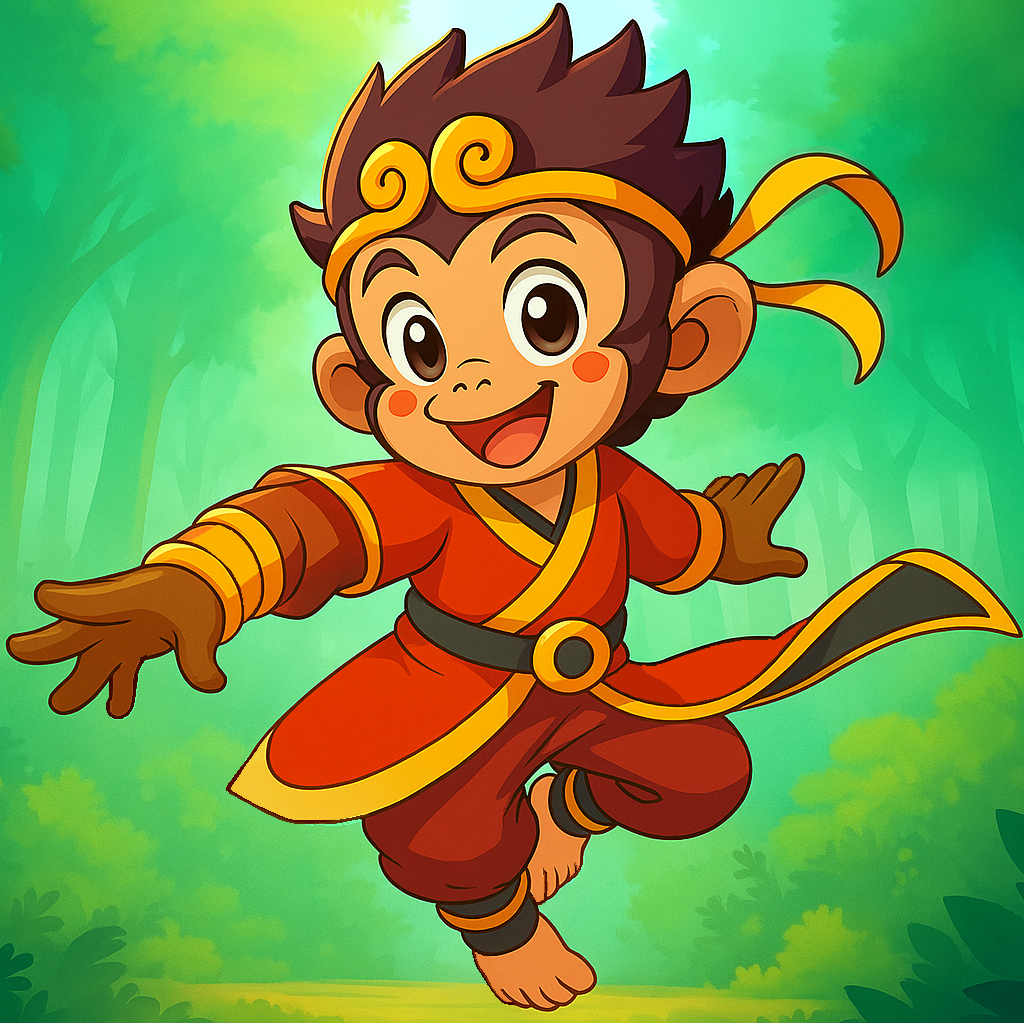
The jungle had rules.
Most of them were sensible.
Do not disturb a sleeping leopard.
Do not eat the red berries unless you knew exactly which red berries they were.
Do not challenge Gorse the boar to anything involving downhill momentum.
And, according to Meimei, do not let Wukong make decisions before breakfast.
Wukong disagreed with the last one.
He disagreed loudly.
“Breakfast is when I’m at my most creative.”
“You are at your most unconscious,” Meimei said.
Wukong considered this.
“That’s still creative.”
He launched himself from the branch.
Meimei watched him go.
Kai watched him go.
A small green bird watched him go.
The bird immediately flew away.
Wukong hit the first branch.
CRACK.
He hit the second.
CRACK.
He disappeared into a bush.
There was a moment of silence.
Then:
“Did you SEE that landing?”
Meimei closed her eyes.
Kai looked down from his branch.
“You landed in a bush.”
“It was a controlled descent.”
“You fell.”
“With control.”
“You screamed.”
“That was communication.”
A frog hopped out of the bush.
Wukong looked after it.
“The frog broke my fall.”
“The frog has left,” Meimei said.
“He understands heroism.”
“The frog understands survival.”
Wukong stood, brushing leaves out of his fur.
A thorn was stuck in his tail.
He hadn’t noticed.
Meimei did.
She pointed.
“You have a problem.”
“I have several.”
“Your tail.”
Wukong looked.
“Oh.”
He reached back.
Missed.
Tried again.
Missed again.
Kai sighed.
“Hold still.”
He climbed down, removed the thorn, and tossed it aside.
Wukong looked at him.
“Thanks.”
“You’re welcome.”
“I could’ve gotten it.”
“You were trying to bite your own tail.”
“I was improvising.”
Meimei smiled.
“That’s what we call your entire personality.”
The three of them continued through the fig trees.
This was how their mornings usually went.
Not because they were careless.
Not entirely.
They were young.
They were siblings.
And the jungle had always belonged to them.
Or at least, they had believed it did.
Their home was a collection of old fig and ironwood trees overlooking a slow brown river. Their sleeping places were woven into branches and roots, their food gathered from the valley, their paths known by memory rather than markings.
Nobody had given the place a name.
It had never needed one.
Wukong could find his way home blind.
Meimei could count the ridges.
Kai could tell which branches would hold weight and which ones would snap.
They knew the river’s moods.
They knew the calls of the birds.
They knew which snakes were dangerous.
They knew where Gorse the boar slept.
They knew which trees gave fruit in the early rains.
They knew everything.
That was the problem.
They didn’t know what they didn’t know.
By midday, the three siblings were arguing about who was funniest.
This was not unusual.
It had become a recurring dispute, although nobody could remember how it had started.
“It is obviously me,” Wukong said.
“No,” said Kai.
“Yes.”
“No.”
“Yes.”
“You fell into a bush this morning.”
“And everybody laughed.”
“At you.”
“Still counts.”
Meimei folded her arms.
“You know what? I think it’s me.”
Both brothers turned.
“You?” Kai asked.
“Yes.”
Wukong stared.
“You aren’t even trying.”
“Exactly.”
Kai laughed.
Meimei pointed at him.
“See? Funny.”
Wukong jumped onto a branch.
“I can be funny.”
“You’re loud.”
“Loud is funny.”
“No,” Meimei said. “Loud is loud.”
Wukong thought about this.
Then he spotted a heron standing motionless in the river.
“That bird has been there since morning.”
Meimei looked.
The heron had not moved.
“That heron is committing to something,” she said.
“I respect it.”
Kai smiled.
For a little while, nothing was wrong.
Then he noticed the birds.
He had been noticing them for three days.
They stopped at the ridge.
Every species.
Every direction.
No birds crossed it.
Kai’s smile disappeared.
“Has anyone else noticed that?”
Wukong looked up.
“Noticed what?”
“The birds.”
“Birds.”
“They don’t go past the ridge.”
Wukong looked.
Meimei looked.
The three of them watched the sky.
A flock approached the ridge.
Then turned.
All at once.
No hesitation.
No scattered movement.
They simply changed direction.
Meimei’s expression tightened.
“That’s strange.”
Wukong shrugged.
“Birds are dramatic.”
“Three days?”
“Very dramatic birds.”
Kai shook his head.
“For three days? All of them? That’s not drama.”
He looked toward the ridge.
“That’s a decision.”
None of them knew it yet, but that was the first warning.
Not the shadow.
Not the stones.
Not the strange woman who would eventually become their guardian.
The first warning was simply that the birds had decided there was somewhere they no longer wanted to go.
That evening, the three siblings sat together above the river.
The sunset turned the water orange.
Wukong was eating a fig.
Meimei was counting stars.
Kai was watching the ridge.
Wukong tossed the fig stem at him.
Kai caught it without looking.
“You’ve been staring at that ridge for an hour.”
“I know.”
“You know it’s still there?”
“I know.”
“Good. I was worried you’d lost it.”
Kai looked at him.
“Do you ever stop?”
“No.”
Meimei looked up from the stars.
“Unfortunately.”
Wukong grinned.
Then, without warning, he jumped.
Not from the branch.
Straight upward.
He caught another branch almost twice his height.
Kai stared.
“You couldn’t reach that yesterday.”
Wukong looked down.
“Sure I could.”
“You couldn’t.”
“I’ve always been able to.”
Meimei frowned.
“Have you?”
Wukong opened his mouth.
Then stopped.
He didn’t know.
For a moment, none of them spoke.
Then Wukong smiled.
“Maybe I’m getting taller.”
Kai laughed.
“You’re getting something.”
“Muscles?”
“Problems.”
Wukong jumped again.
Higher.
For just a fraction of a second, he seemed almost weightless.
He landed perfectly.
He looked surprised.
Meimei noticed.
She didn’t say anything.
She simply watched him.
Later that night, Wukong dreamed of stone.
He stood on a mountain he didn’t recognize.
There was a waterfall.
Behind it, a cave.
Monkeys laughing.
A staff standing in darkness.
A voice saying his name.
Wukong.
He woke before dawn.
His heart was pounding.
He looked around.
Kai was asleep.
Meimei was asleep.
The jungle was quiet.
Wukong touched his chest.
He didn’t know why the dream felt like something he had forgotten rather than something he had imagined.
Outside, somewhere beyond the trees, a bird screamed.
Then another.
Then silence.
Wukong sat up.
For the first time in his life, he was afraid to go looking.
So he stayed.
The jungle had many dangers.
There were snakes.
There were leopards.
There were cliffs.
There were rivers that became much less friendly after heavy rain.
And then there was Gorse.
Gorse was a boar.
He was not the biggest boar in the valley.
He was not the fastest.
He was not even particularly clever.
What Gorse possessed instead was an almost supernatural commitment to being angry.
He was angry at the rain.
He was angry at the sun.
He was angry at mosquitoes.
He was once angry at a rock.
For existing.
Meimei had never let anyone forget that.
“The rock was where it had always been,” she said.
Wukong sat upside down from a branch.
“So Gorse attacked it?”
“Of course.”
“What happened?”
“The rock won.”
Wukong nodded solemnly.
“Strong rock.”
Kai looked down from the branch above them.
“You know, I think we should leave Gorse alone.”
Wukong looked up.
“Why?”
“Because he’s a boar.”
“I know what he is.”
“And he has tusks.”
“I’ve seen them.”
“And he’s bigger than you.”
Wukong frowned.
“That sounds like jealousy.”
Kai sighed.
“That’s not what jealousy means.”
“That’s what someone jealous would say.”
Meimei was already walking away.
“Please don’t encourage him.”
“I haven’t.”
“You’ve spoken to him.”
“That is encouragement.”
Wukong dropped from the branch.
He landed beside her.
Perfectly.
Meimei glanced at his feet.
Then at him.
Then back at his feet.
Wukong noticed.
“What?”
“Nothing.”
“You did the face.”
“What face?”
“The face.”
“I don’t have a face.”
“You absolutely have a face.”
“So do you.”
“Mine is handsome.”
“That’s unfortunate.”
Wukong grinned.
Meimei tried not to smile.
She failed.
Kai noticed.
“You’re encouraging him.”
“I know.”
They continued down through the trees.
The lower valley was warmer.
The ground was softer.
And somewhere ahead, Gorse was making the unmistakable sound of a boar having a terrible morning.
SNORT.
Wukong stopped.
Meimei stopped.
Kai stopped.
Another snort.
Wukong’s eyes widened.
“He’s awake.”
Kai immediately turned around.
“We’re leaving.”
“Why?”
“Because I have learned from experience.”
“You don’t have experience.”
“I have you.”
“That’s insulting.”
“It’s accurate.”
Wukong looked toward the sound.
Then toward Meimei.
Then back toward the sound.
He smiled.
Meimei saw the smile.
“No.”
“I didn’t say anything.”
“You didn’t need to.”
“I’m just standing here.”
“You’re standing here with that face.”
“What face?”
“The face you make immediately before something catches fire.”
Wukong’s smile became wider.
“I have an idea.”
Kai groaned.
“Of course you do.”
The old fig tree stood at the edge of the lower valley.
It was enormous.
Its branches spread across the clearing like a giant hand.
During the dry season, its roots became a favorite resting place for half the jungle.
During the wet season, its leaves collected enough rain to make the ground beneath it permanently muddy.
And every year, when the flowers fell, the entire tree became covered in pale pink petals.
Wukong looked up.
Then down.
Then up again.
Meimei followed his eyes.
“No.”
“You don’t even know what I’m thinking.”
“I know exactly what you’re thinking.”
“What am I thinking?”
“You’re thinking that if you pull that vine, all those petals will fall on Gorse.”
Wukong stared at her.
Meimei stared back.
Kai stared at both of them.
Wukong slowly smiled.
“You’re very good at this.”
“I’ve known you your entire life.”
“Then you know this is a good idea.”
“No.”
“Excellent.”
He jumped onto the first branch.
Kai grabbed his tail.
Wukong looked down.
“Let go.”
“No.”
“Why?”
“Because this is the moment where you normally do something stupid.”
“I’m offended.”
“Good.”
Meimei walked beneath them.
“There is one thing.”
Kai looked at her.
“What’s that?”
She pointed upward.
“The vine.”
Wukong looked.
The vine was thick.
Old.
Strong.
Perfect.
He grinned.
“Done.”
He climbed.
Kai released his tail.
Wukong immediately swung himself around the branch.
Meimei watched.
“You’re going to fall.”
“I am not.”
“You always say that.”
“Because it’s always true.”
“You fell yesterday.”
“Yesterday was different.”
“You landed on a frog.”
“The frog was fine.”
“The frog moved out of the valley.”
“He’s starting a new life.”
Meimei shook her head.
Wukong reached the vine.
He wrapped one hand around it.
Then the other.
He looked down.
Gorse was moving below.
The boar had no idea what was coming.
Wukong looked back at his siblings.
“Ready?”
Kai folded his arms.
“No.”
Meimei nodded.
“Yes.”
Wukong looked between them.
“I choose Meimei.”
“Obviously.”
“On my signal.”
Meimei narrowed her eyes.
“And what exactly is your signal?”
Wukong grinned.
“This.”
He pulled.
Nothing happened.
Wukong pulled harder.
Still nothing.
Meimei waited.
Kai waited.
A bird landed on a nearby branch.
It waited too.
Wukong’s face tightened.
“Come on.”
He pulled again.
The vine moved.
The branch above them creaked.
Meimei’s eyes widened.
“Wukong.”
“I’ve got it.”
“Wukong.”
“I’ve got it.”
“Wukong.”
“I KNOW.”
The vine snapped.
The entire tree seemed to exhale.
Then the petals came down.
All of them.
Thousands upon thousands of pale pink petals poured from the branches.
Gorse disappeared.
For one beautiful second, there was nothing but pink.
Then came the snort.
It was enormous.
It rolled across the valley.
Birds exploded from the trees.
A family of monkeys fled in three different directions.
Something in the river splashed.
And Gorse emerged.
Covered from head to hoof in petals.
He stood perfectly still.
Wukong stared.
Kai stared.
Meimei stared.
Gorse blinked.
A petal slid slowly down his snout.
Another landed between his eyes.
Wukong whispered,
“Oh.”
Kai whispered,
“We should run.”
Meimei nodded.
“Immediately.”
Gorse screamed.
Not a normal boar sound.
A sound that suggested he had discovered a personal betrayal on a spiritual level.
Wukong burst out laughing.
“You look BEAUTIFUL!”
Gorse charged.
“Oh.”
Wukong jumped.
He caught the branch.
Gorse crashed into the tree.
THUD.
Wukong swung around the branch.
Kai grabbed Meimei.
They ran.
Gorse followed.
Or tried to.
The petals had gotten into his ears.
He shook his head.
More petals flew everywhere.
Wukong was laughing so hard he could barely climb.
“LOOK AT HIM!”
“CLIMB!” Kai shouted.
“I AM CLIMBING!”
“FASTER!”
“I’m laughing!”
“That’s not helping!”
Meimei reached the upper branch and looked down.
Gorse was still trying to understand what had happened.
A petal fell from his head.
He stared at it.
Then at them.
Then at the tree.
Then back at them.
Meimei covered her mouth.
Wukong saw her.
“You think it’s funny too!”
“I do not.”
“You do!”
“I absolutely do.”
Kai laughed.
That was enough.
The three of them collapsed against the branches.
For several minutes, nobody could breathe properly.
Wukong wiped his eyes.
“Did you see his face?”
Meimei was still laughing.
“I saw.”
“He looked like—”
“An angry flower.”
Kai lost it again.
Wukong pointed at him.
“That’s the one!”
Gorse snorted below.
All three siblings went silent.
He was staring up at them.
Wukong slowly raised one hand.
“Sorry?”
Gorse charged the tree.
Wukong screamed.
“NOT SORRY!”
They ran.
By the time they reached the high canopy, Gorse had given up.
Or perhaps he had simply decided that revenge would be more satisfying later.
Nobody knew.
Wukong certainly didn’t care.
He was too busy retelling the story.
“And then—”
“You already told it.”
“That was the first version.”
“There are versions?”
“Of course.”
Kai looked at Meimei.
“How many?”
Wukong thought.
“Three.”
“It happened ten minutes ago.”
“I’ve had time.”
Meimei shook her head.
“You are going to make that story worse every time.”
“Better.”
“Worse.”
“More heroic.”
“You fell out of the tree.”
“I swung dramatically.”
“You screamed.”
“Battle cry.”
“You hid behind Kai.”
“Tactical repositioning.”
Kai raised a finger.
“For accuracy, he hid behind me.”
Wukong pointed at him.
“See? Tactical.”
Meimei laughed again.
They settled onto a broad branch overlooking the valley.
The sun was lower now.
The jungle had returned to its usual rhythm.
Birds moved through the canopy.
Leaves whispered in the breeze.
The river glimmered between the trees.
For a while, it was perfect.
Then Wukong stopped laughing.
He looked upward.
Meimei noticed first.
She always noticed first.
“What?”
Wukong didn’t answer.
Kai followed his gaze.
“What are you looking at?”
“Up there.”
“There are trees.”
“I know.”
“Congratulations.”
Wukong ignored him.
He was looking into the highest part of the canopy.
Something had moved.
Not much.
A branch.
Just one.
But it was moving in the wrong direction.
The wind was blowing east.
The branch was moving west.
Wukong stood.
“There was someone there.”
Kai looked.
“I don’t see anyone.”
“I did.”
Meimei climbed onto the branch beside him.
“Where?”
“Up there.”
“How long ago?”
“Just now.”
They waited.
Nothing.
A bird landed on the branch.
Wukong stared at it.
The bird stared back.
Then it flew away.
Wukong frowned.
“Not the bird.”
Meimei smiled.
“I figured.”
Kai sighed.
“You two are impossible.”
Wukong looked at him.
“You’re just jealous because we see mysterious things.”
“I don’t want to see mysterious things.”
“That’s because you’re boring.”
“That’s because I enjoy surviving.”
Meimei looked toward the darkening canopy.
“Whoever it was, they were watching us.”
Wukong’s smile faded.
“Yeah.”
Kai looked at him.
“You sure?”
Wukong nodded.
“I know what being watched feels like.”
Nobody asked how.
Because Wukong didn’t know.
He only knew that something about the feeling was familiar.
They should have gone home.
Instead, Wukong went looking.
Of course he did.
Meimei followed because someone had to make sure he didn’t accidentally discover a tiger.
Kai followed because someone had to make sure Meimei didn’t accidentally discover that Wukong had discovered a tiger.
They moved carefully through the upper branches.
The light beneath them had begun turning blue.
Wukong stopped.
“Here.”
Meimei landed beside him.
“What?”
He pointed.
The branch was still moving.
Slowly.
Back and forth.
There was nobody on it.
Kai landed behind them.
“Maybe it was the wind.”
Wukong shook his head.
“The wind isn’t doing that.”
Kai looked around.
“Then what is?”
Nobody answered.
Wukong reached toward the branch.
He touched it.
Warm.
Someone had been there recently.
Very recently.
His fingers tightened around the bark.
Then he felt something else.
A strange pressure in his chest.
Not fear.
Not exactly.
Recognition.
He looked toward the ridge.
The same ridge the birds refused to cross.
The same ridge Kai had been watching for days.
The jungle beyond it was darker than the rest.
Wukong stared.
For just a moment, he thought he saw a figure standing between the trees.
Small.
Still.
Watching.
He blinked.
Gone.
“Wukong?”
He didn’t answer.
Meimei touched his shoulder.
He flinched.
She pulled her hand back.
“Sorry.”
“No.”
He shook his head.
“Sorry.”
Kai looked between them.
“What did you see?”
Wukong looked toward the ridge again.
“I don’t know.”
That answer frightened him more than any other answer could have.
Because Wukong always had an answer.
Even when it was wrong.
Especially when it was wrong.
Meimei studied his face.
“Let’s go home.”
Wukong nodded.
This time, he didn’t argue.
They were halfway home when Wukong heard it.
A sound.
Very faint.
Behind them.
He stopped.
Kai almost walked into him.
“What?”
Wukong listened.
Nothing.
Then—
A twig snapped.
Meimei turned.
The three siblings stood together.
Nobody spoke.
Another branch moved.
Then another.
Something was following them.
Wukong’s heart began beating faster.
Kai moved closer.
Meimei moved to the other side.
They continued.
Together.
The sound followed.
They walked faster.
It followed faster.
They stopped.
It stopped.
Wukong looked at his siblings.
Kai whispered,
“Don’t.”
“I wasn’t going to.”
“You were absolutely going to.”
“I was thinking.”
“That’s worse.”
Meimei looked into the trees.
“We don’t know what it is.”
Wukong swallowed.
“Then we should probably find out.”
Kai stared at him.
“That is exactly the opposite of what we should do.”
Wukong considered this.
“You’re right.”
Kai looked relieved.
Wukong turned around.
“We should find out tomorrow.”
Kai closed his eyes.
“Of course.”
Meimei laughed softly.
And somehow, that broke the fear.
They hurried home together.
Three siblings.
One behind the other.
Close enough that their shoulders bumped as they moved.
None of them looked back.
But somewhere above them, hidden among the branches, someone watched them go.
And somewhere beyond the ridge, something else listened.
The jungle had heard their laughter.
It had heard their voices.
It had heard Wukong’s ridiculous victory cry.
And for the first time in a very long time, something in the dark had heard something worth following.
The watcher did not move.
Not yet.
But it had noticed him.
Wukong.
Getting lost did not feel like getting lost at first.
It felt like taking one wrong turn.
Then another.
Then a third, followed by Kai confidently announcing that he knew exactly where they were.
“I know the way.”
Meimei looked at him.
“Good.”
Kai smiled.
“I know exactly the way.”
Meimei stopped walking.
Wukong stopped too.
They both looked at him.
Kai looked back.
“What?”
Meimei pointed behind them.
“Which way did we come from?”
Kai opened his mouth.
Closed it.
Looked left.
Then right.
Then up.
The trees did not help.
Wukong waited.
Kai cleared his throat.
“We’re orienting.”
Meimei folded her arms.
“You’re standing.”
“I’m orienting while standing.”
“That’s a technique?”
“A very advanced one.”
Wukong nodded thoughtfully.
“I’ve heard of it.”
“You have not.”
“I have now.”
Meimei started walking again.
“Come on.”
Kai followed.
Wukong fell into step beside them.
After a moment, he looked at Kai.
“So where are we?”
“East.”
“Are you sure?”
“Yes.”
“How sure?”
Kai hesitated.
“Very.”
Meimei looked over.
“He said it twice.”
Wukong nodded.
“That’s how we know he isn’t.”
Kai sighed.
“I know where we are.”
“Excellent.”
“We’re in the jungle.”
Wukong stared at him.
“That’s not helpful.”
“It’s accurate.”
“So is saying I’m a monkey.”
“You are a monkey.”
“Exactly. Completely useless.”
Meimei laughed.
Kai looked offended.
“You two are impossible.”
Wukong grinned.
“You’re just jealous.”
“Of what?”
“Our ability to get lost.”
“I am not jealous of that.”
“You should be.”
“Why?”
“Because we’re very good at it.”
They had not meant to go this far.
That was the important part.
They had been following the sound of running water.
The stream was supposed to lead back toward the river.
That had been Meimei’s idea.
Then the stream had split.
They had followed the larger branch.
Then the larger branch had disappeared beneath a wall of roots.
Then Wukong had spotted a fruit tree.
Then Kai had spotted another fruit tree.
Then Wukong had challenged him to see who could reach it first.
Then both of them had climbed the wrong tree.
Then Meimei had suggested they turn around.
Nobody had listened.
This was how they had arrived here.
The trees were different.
Not dramatically.
Just enough.
The bark seemed darker.
The vines were thicker.
Even the air felt different.
The familiar sounds of home had faded behind them.
No Gorse.
No river.
No familiar birds.
No distant calls from the monkeys who lived near the eastern fig trees.
Wukong noticed first.
He stopped.
Meimei nearly walked into him.
“What?”
Wukong looked around.
“It’s quiet.”
Kai listened.
He didn’t like what he heard.
Nothing.
Not real nothing.
There were still insects.
Leaves still moved.
Somewhere far away, water dripped.
But the jungle’s usual noise was missing.
It felt as though the forest was holding its breath.
Meimei looked at the trees.
“We should head back.”
Kai nodded.
“Agreed.”
Wukong looked behind them.
“Which way?”
Neither answered.
Wukong waited.
Meimei pointed.
“That way.”
Kai pointed the opposite direction.
“That way.”
Wukong looked between them.
“You both seem very confident.”
Meimei looked at Kai.
Kai looked at Meimei.
Meimei lowered her hand.
“Fine.”
Kai lowered his.
“Fine.”
Wukong smiled.
“I’ll lead.”
“No,” they said together.
Wukong looked offended.
“Why not?”
“Because you’re the reason we’re lost,” Kai said.
“I’m not the reason.”
Meimei raised an eyebrow.
“You challenged Kai to race through the trees.”
“That was unrelated.”
“You chose the wrong tree.”
“It looked right.”
“You ate the fruit.”
“It was good.”
“It was poisonous.”
Wukong paused.
“It was mostly good.”
Kai stared at him.
“You spent ten minutes upside down.”
“I was thinking.”
“You were sick.”
“I was thinking while sick.”
Meimei rubbed her forehead.
“Let’s just find the river.”
They started walking.
Again.
They found the stone because Wukong walked into it.
There was a loud THUNK.
Wukong stumbled backward.
“Ow.”
Kai turned.
“What happened?”
Wukong rubbed his forehead.
“Tree.”
Meimei looked at the object behind him.
“That’s not a tree.”
Wukong looked.
“Oh.”
It was enormous.
The stone rose from the ground between the roots of two ancient trees.
Half of it was buried.
Moss covered the lower section.
Roots curled around its sides.
The upper portion was exposed to the sky.
And carved into the stone were markings.
Deep ones.
Careful ones.
The kind of markings made by someone who had wanted them to survive.
Wukong touched his forehead.
Then the stone.
“Why does everything in this jungle keep hitting me?”
Meimei stepped closer.
“Maybe stop walking into things.”
“I was exploring.”
“You were looking at a butterfly.”
“It was an interesting butterfly.”
Kai crouched beside the stone.
“These aren’t animal marks.”
Meimei brushed moss away with her fingers.
“No.”
She stared at the carving.
“I’ve seen marks like these before.”
Wukong leaned closer.
“Can you read them?”
“No.”
“You said you’ve seen them.”
“I said I’ve seen marks like them.”
“So you can’t read them.”
“I didn’t say that.”
Wukong smiled.
“You can’t.”
Meimei pushed him away from the stone.
“Move.”
“Why?”
“You’re blocking the light.”
Wukong moved.
Barely.
Meimei gave him a look.
He moved another inch.
She sighed.
“Thank you.”
Kai studied the stone.
“How old is it?”
Meimei shook her head.
“Old.”
“That’s not a number.”
“I know.”
“Can you tell?”
She ran her fingers over the grooves.
“Older than the trees.”
Wukong looked at the trees.
“How old are the trees?”
“Very.”
“Helpful.”
“You’re welcome.”
Wukong crouched.
There was something about the stone.
He couldn’t explain it.
He had touched hundreds of rocks.
He had climbed thousands of trees.
He had slept on warm stones beside the river.
But this one felt different.
It was almost warm.
Not from the sun.
From inside.
Wukong pulled his hand back.
Meimei noticed.
“What?”
“Nothing.”
“You made a face.”
“I didn’t.”
“You did.”
Kai looked over.
“He did.”
Wukong frowned.
“Traitor.”
Kai smiled.
“I’m observant.”
“You’re annoying.”
“You’re both annoying.”
Meimei continued examining the carving.
Then she noticed the sky.
The sun had dropped lower than she expected.
Much lower.
She looked through the trees.
“We need to find somewhere to sleep.”
Kai looked around.
“Here?”
Meimei shook her head.
“Too exposed.”
Wukong pointed.
“That branch.”
“It’s dead.”
“That one?”
“Too thin.”
“That one?”
“Too high.”
Wukong stared at her.
“You just rejected every tree.”
“Because you’re choosing trees that would kill you.”
“They wouldn’t kill me.”
“The branch is dead.”
“I’ve survived worse.”
“You fell into a bush yesterday.”
“That bush was very dangerous.”
Kai laughed.
Meimei smiled despite herself.
“Come on.”
They moved deeper into the trees.
The stone remained behind them.
Silent.
Watching nothing.
Or perhaps waiting.
Night came quickly.
Much too quickly.
They eventually found a broad tree with a hollow beneath its roots.
It wasn’t home.
But it was dry.
That was enough.
Kai gathered leaves.
Meimei checked the surrounding ground.
Wukong climbed the tree.
Then climbed back down.
Then climbed up again.
Kai looked at him.
“What are you doing?”
“Checking.”
“You checked it.”
“I’m checking again.”
“You checked it twice.”
“Three times.”
“Why?”
Wukong looked down.
“I don’t know.”
Kai stared at him.
Wukong shrugged.
“Feels wrong.”
That stopped Kai.
Meimei looked up.
“What feels wrong?”
Wukong looked toward the trees.
“I don’t know.”
The three of them went quiet.
Then a night bird called.
Meimei looked up.
She knew that call.
“Not dangerous.”
Wukong relaxed.
Kai sat against the roots.
“Good.”
Meimei gathered a few dry leaves.
“Get some sleep.”
Wukong curled his tail around himself.
“What about you?”
“I’ll stay awake.”
Kai immediately shook his head.
“No.”
Meimei looked at him.
“Why?”
“Because you always say that and then fall asleep.”
“I do not.”
“You fell asleep while counting stars.”
“I was resting my eyes.”
“For an hour?”
“I was very tired.”
Wukong grinned.
“I can stay awake.”
Both of them looked at him.
Meimei laughed.
“You?”
“I can be responsible.”
Kai smiled.
“That is the funniest thing you’ve said all day.”
Wukong threw a leaf at him.
Kai caught it.
“See?”
“You’re proving my point.”
Wukong curled up.
“I hate both of you.”
“No, you don’t,” Meimei said.
Wukong was quiet.
Then:
“No.”
Meimei smiled.
“I know.”
Wukong woke sometime later.
He didn’t know why.
The jungle was dark.
Kai was asleep.
Meimei was asleep.
The moon was high above the canopy.
Wukong sat up.
Something had changed.
He could feel it.
He looked around.
Nothing.
He stepped out from beneath the roots.
The night air was cool.
He could see more clearly than he should have been able to.
The branches above him seemed almost silver.
He looked up.
Stars.
Thousands of them.
He had seen stars before.
But never like this.
Without the thick canopy of home blocking most of the sky, the heavens stretched endlessly above him.
Wukong stared.
Then he heard movement.
Meimei stepped out beside him.
“You couldn’t sleep either?”
Wukong shook his head.
“No.”
She followed his gaze.
“Oh.”
Wukong looked at her.
“What?”
“Nothing.”
“You did the face.”
“What face?”
“The face where you know something.”
Meimei smiled.
“Grandmother taught us about the stars.”
Wukong looked up.
“She taught you.”
“She tried to teach all of us.”
“Grandmother knew the stars?”
“She knew more than the stars.”
“What else?”
“Which mushrooms were safe.”
“That’s more useful.”
“Which rivers flooded first.”
“Also useful.”
“Which people lied.”
Wukong looked at her.
“She could tell?”
“Usually.”
“Could she tell when you lied?”
Meimei smiled.
“Always.”
Wukong frowned.
“That’s terrifying.”
“Yes.”
Meimei sat on a root.
Wukong sat beside her.
She pointed upward.
“See those three?”
Wukong squinted.
“Those?”
“Yes.”
“They look like three stars.”
“They are three stars.”
“Excellent.”
Meimei laughed.
“They make a shape.”
“What shape?”
“That depends on who you ask.”
Wukong looked harder.
“I see a chicken.”
Meimei stared at him.
“A chicken?”
“Very brave chicken.”
“There is no chicken.”
“You can’t prove that.”
She pointed again.
“Those stars tell me which direction is north.”
Wukong tilted his head.
“How?”
“You learn where they appear. How they move. Which ones stay fixed.”
“Some don’t move?”
“Not the way you think.”
Wukong stared at the sky.
Something strange happened.
The stars seemed to shift.
Not physically.
Something inside him shifted.
For a heartbeat, the forest disappeared.
He was somewhere else.
Stone beneath his feet.
Wind against his face.
A mountain rising beneath an endless sky.
He could see a waterfall.
Could hear rushing water.
And behind it—
A cave.
Wukong blinked.
The jungle returned.
He was still sitting beside Meimei.
His heart was beating hard.
She noticed.
“You okay?”
Wukong swallowed.
“Yeah.”
“What happened?”
“Nothing.”
She studied him.
“You made the face again.”
“I don’t have a face.”
“Everyone has a face.”
“Not me.”
“Especially you.”
He looked back at the stars.
There was something familiar about them.
Something he couldn’t explain.
He had never been on that mountain.
He knew that.
He had never seen that waterfall.
He knew that too.
But somehow—
He remembered it.
Or something remembered him.
“There’s something wrong with those stars.”
Meimei looked at him.
“Wrong?”
“They’re moving.”
“They always move.”
“No.”
Wukong pointed.
“That one.”
Meimei followed his finger.
“The star?”
“Yes.”
“It’s supposed to be there.”
“Why?”
“Because that’s where it is.”
Wukong frowned.
“That’s not an answer.”
“It is if you’re a star.”
He considered this.
“Stars are confusing.”
“That’s why you need to learn them.”
“Can you teach me?”
Meimei smiled.
“Maybe.”
“Tonight?”
“Tonight.”
“Now?”
“You don’t know any of them.”
“I know that one.”
“Which one?”
“That one.”
He pointed randomly.
Meimei looked.
“That’s a cloud.”
Wukong lowered his hand.
“Oh.”
She laughed.
Wukong smiled.
For a while, they sat beneath the stars.
No danger.
No arguments.
No strange stones.
Just the two of them.
Meimei quietly naming stars.
Wukong trying to remember them.
He got almost every one wrong.
Eventually she gave up.
“You know what?”
“What?”
“You can learn tomorrow.”
Wukong yawned.
“I already know one.”
“Which?”
He pointed at the brightest star.
“That one.”
“That’s not its name.”
“I named it.”
“What did you name it?”
Wukong thought.
“Meimei.”
She stared at him.
“Why?”
“Because you’re always pointing at it.”
She smiled.
“You are terrible at astronomy.”
“I know.”
“And yet somehow—”
She stopped.
Wukong looked at her.
“Somehow what?”
“Nothing.”
She leaned against him.
Wukong stayed still.
For once.
Morning came with Kai shouting.
“WAKE UP!”
Wukong opened one eye.
“No.”
Kai shook his shoulder.
“Wake up!”
“No.”
“Something’s wrong.”
Wukong sat up immediately.
“What?”
Kai pointed.
“The stone.”
Meimei was already awake.
They ran.
The stone stood where they had left it.
But the carving had changed.
Not much.
Just one mark.
A line that had been hidden beneath moss was now visible.
Meimei knelt.
She brushed the stone clean.
Her expression changed.
“What?”
Kai crouched beside her.
“What is it?”
“I don’t know.”
Wukong looked.
The symbol was simple.
Almost like a circle.
Almost like a cloud.
But beneath it was another shape.
Long.
Straight.
Like a staff.
Wukong reached toward it.
Meimei grabbed his wrist.
“Don’t.”
He looked at her.
“Why?”
“I don’t know.”
“Then why not?”
“Because every strange thing we’ve found lately has gotten worse after you touch it.”
Wukong considered that.
“That’s fair.”
He lowered his hand.
Then the stone vibrated.
Very softly.
All three froze.
Wukong looked at Kai.
Kai looked at Meimei.
Meimei looked at the stone.
Nobody spoke.
The vibration stopped.
Wukong slowly smiled.
“Did anyone else feel that?”
Kai nodded.
“Yes.”
Meimei stood.
“We’re going home.”
Wukong looked at the carving one last time.
The symbol seemed almost familiar.
Like something from his dream.
Something from the mountain.
Something from before.
But before what?
He didn’t know.
He followed his siblings.
Behind them, the stone remained silent.
And above them, the morning sky was clear.
Almost clear.
One star was still visible.
Even though it should have disappeared with the dawn.
Meimei noticed it.
She stopped.
Wukong stopped too.
“What?”
She pointed.
He looked.
The star remained.
Bright.
Watching.
Wukong felt that strange pressure in his chest again.
For just a moment, he thought he heard laughter.
Not Meimei’s.
Not Kai’s.
Not his own.
Something distant.
Something impossibly old.
Then the star vanished.
Meimei lowered her hand.
“Let’s go.”
Wukong nodded.
This time, he didn’t ask questions.
He simply followed.
But as they disappeared into the trees, the stone behind them gave one final, almost imperceptible tremor.
And far beyond the ridge, something ancient had begun to remember.
The jungle did not become quiet all at once.
It became quiet in pieces.
First the insects stopped.
Then the birds.
Then even the river seemed too far away.
Wukong noticed the fruit first.
There was an entire grove of it.
Ripe figs.
Yellow berries.
Small red fruits that Meimei had specifically told him not to eat because they made your tongue numb.
Usually, the grove would have been chaos.
Birds would be fighting over branches.
Monkeys would be shouting.
Something would be chewing on something else.
Instead, there was nothing.
Wukong stared at the fruit.
Then at the trees.
Then back at the fruit.
“Free food.”
Meimei stopped.
“Yes.”
“That’s suspicious.”
“It’s fruit.”
“Exactly.”
Meimei sighed.
“You don’t trust fruit?”
“I trust fruit.”
“You just called it suspicious.”
“I trust it suspiciously.”
Kai looked around.
“Something’s wrong.”
Wukong looked at him.
“With the fruit?”
“With everything.”
That made Wukong stop smiling.
Kai was rarely dramatic.
Mostly because Meimei was dramatic enough for everyone.
If Kai said something was wrong, something was usually wrong.
Wukong looked through the trees.
The branches moved gently overhead.
But there were no birds.
No calls.
No wingbeats.
Nothing.
Meimei’s voice became quieter.
“The birds still aren’t crossing the ridge.”
Kai nodded.
“They haven’t for days.”
Wukong looked toward the ridge.
It seemed farther away than usual.
Not because it had moved.
Because the jungle between them suddenly felt enormous.
“Maybe they know something.”
Kai glanced at him.
“Birds know a lot.”
Wukong nodded.
“That’s why I don’t trust them.”
Meimei smiled faintly.
“You’re afraid of birds now?”
“No.”
“You sound afraid.”
“I’m respectful.”
“Of birds.”
“Very respectful.”
Kai started walking.
“Come on.”
Wukong followed.
Meimei followed Wukong.
They made it six steps.
Then Wukong stopped.
“Wait.”
Kai turned.
“What?”
Wukong pointed.
“That.”
Four long gouges cut across the trunk of an ironwood.
They were deep.
Far too deep.
The pale wood underneath showed where something had torn through the bark.
Kai stepped closer.
He touched one of the marks.
His expression changed.
“Nothing in this valley makes that.”
Wukong leaned forward.
“Could be a really committed woodpecker.”
Kai looked at him.
“It’s not a woodpecker.”
“A big one.”
“Wukong.”
“An ambitious one.”
“Wukong.”
“Very motivated.”
“Wukong.”
“Fine.”
Wukong stopped talking.
Meimei looked at the marks.
Then she looked down.
There were tracks in the soft ground.
Two sets.
The first were large.
Deep.
Four-toed.
The second were smaller.
Neat.
Almost careful.
Meimei crouched.
“Two things came through here.”
Kai knelt beside her.
“The second one followed the first.”
Wukong looked at the tracks.
“Why?”
Meimei touched one of the smaller prints.
“I don’t know.”
Wukong stared toward the ridge.
“Maybe the big one was running away.”
Kai stood.
“From what?”
Nobody answered.
That was the problem.
They didn’t know.
Wukong normally had something to say.
A joke.
A guess.
Something ridiculous.
But now he was quiet.
Meimei noticed.
She always noticed.
Wukong filled silence whenever he could.
He hated empty spaces.
He hated moments when nobody knew what to say.
But this time he didn’t fill the silence.
His shoulders lowered.
His hands loosened.
His eyes stayed fixed on the trees.
Meimei felt a small chill run through her.
He was afraid.
Or ready.
With Wukong, those two things sometimes looked exactly the same.
Kai whispered,
“We should go.”
Wukong nodded.
Then something moved above them.
All three looked up.
A silhouette stood on the ridge.
It was low.
Human-shaped.
But not quite.
It didn’t move like an animal.
It didn’t move like one of the monkeys they knew.
It simply stood there.
Watching.
Wukong stared.
The figure tilted its head.
For one strange moment, Wukong felt as though it was looking directly at him.
Not the three of them.
Him.
He took one step forward.
Kai caught his arm.
“No.”
“I wasn’t going anywhere.”
“You were.”
“I was looking.”
“Look from here.”
Wukong frowned.
“You’re bossy.”
“I’m older.”
“That’s not the same thing.”
“It is when you’re about to do something stupid.”
Meimei watched the ridge.
The figure was still there.
Then the wind moved.
Leaves passed between them.
For a heartbeat, the silhouette disappeared.
When the leaves cleared—
Nothing.
The ridge was empty.
Wukong stared.
“Where did it go?”
Kai looked around.
“I don’t know.”
Meimei’s eyes narrowed.
“It didn’t walk away.”
Wukong looked at her.
“How do you know?”
“Because we’d have seen it.”
A branch moved twenty paces to their left.
All three turned.
A second figure stepped out of the darkness.
Smaller.
Upright.
Holding something in one hand.
The last sunlight caught it.
Metal.
Wukong’s eyes widened.
“THAT ONE.”
The figure stopped.
Wukong pointed.
“That’s the one from the fig tree!”
Kai looked at him.
“The watcher?”
“Yes!”
Meimei stared.
The stranger stared back.
Nobody moved.
Wukong took half a step forward.
The stranger took one step back.
Wukong stopped.
Something about her movement caught his attention.
It was not fear.
She wasn’t startled.
She was calculating.
One foot shifted.
Weight balanced.
Hands relaxed.
Eyes watching everything.
Wukong unconsciously copied the stance.
Meimei noticed.
So did Kai.
Wukong shifted his weight exactly the way the stranger had.
For one brief moment, his body seemed to understand what his mind didn’t.
His feet found the ground perfectly.
His tail balanced behind him.
His shoulders loosened.
He could have sworn he had stood like that before.
Somewhere.
Sometime.
He didn’t know when.
Then the wind lifted a strand of his hair.
The rest of his fur barely moved.
Wukong frowned.
“What was that?”
Kai looked at him.
“What?”
“Nothing.”
Meimei looked between Wukong and the stranger.
The stranger was still watching him.
Then she moved.
One step.
Two.
She jumped.
Not far.
Not high.
Just enough to reach the branch above her.
She landed without making a sound.
Wukong’s eyes widened.
“How did she—”
He jumped after her.
Kai grabbed his tail.
Wukong stopped halfway through the movement.
He looked back.
“Really?”
“Yes.”
“But I could’ve caught her.”
“That is not the point.”
“What is the point?”
“The point is that we’re going home.”
Meimei nodded.
“Agreed.”
Wukong looked at the empty branch.
The stranger was gone.
Again.
He frowned.
“I don’t like her.”
Kai released his tail.
“You don’t know her.”
“Exactly.”
Meimei gave him a look.
“That sentence makes no sense.”
“It makes perfect sense.”
“How?”
“She’s mysterious.”
“So?”
“Mysterious people are suspicious.”
“You’re mysterious.”
Wukong thought about that.
“Thank you.”
“That wasn’t a compliment.”
“I accepted it anyway.”
Kai groaned.
“Can we go home now?”
This time nobody argued.
They moved quickly.
Not running.
Kai wouldn’t let them.
But fast enough that Wukong kept stepping on Meimei’s heels.
“Stop.”
“I’m behind you.”
“You’re stepping on my tail.”
“Your tail is in the way.”
“That’s where tails go.”
“Not in front of me.”
Meimei looked over her shoulder.
“Both of you, quiet.”
Wukong stopped.
Kai stopped.
The jungle had gone silent again.
Wukong listened.
Nothing.
Then—
A soft rustle.
Behind them.
He turned.
Nothing.
Another rustle.
Closer.
Kai moved beside him.
Meimei moved to Wukong’s other side.
They continued.
The sound followed.
They stopped.
It stopped.
Wukong looked at Kai.
Kai looked at Meimei.
Meimei looked at Wukong.
Nobody said anything.
Then Wukong whispered,
“It’s following us.”
Kai nodded.
“Yes.”
Meimei’s eyes stayed on the trees.
“Don’t look back.”
Wukong immediately looked back.
“Why?”
Meimei closed her eyes.
“Because I knew you would.”
Wukong turned forward again.
“Did you see anything?”
“No.”
“Then why not look?”
“Because sometimes not seeing something is safer.”
Wukong thought about that.
“That’s depressing.”
“It’s also true.”
They kept moving.
The sound followed.
Every time they stopped, it stopped.
Every time they moved, it moved.
Wukong’s heart began beating faster.
But he didn’t tell them.
Kai was already tense.
Meimei was trying not to show that she was frightened.
Someone had to pretend everything was fine.
Wukong usually volunteered for that job.
So he smiled.
“Maybe it’s Gorse.”
Kai looked at him.
“Gorse?”
“He’s angry.”
“At us?”
“Probably.”
“Why?”
Wukong thought.
“Petals.”
Meimei almost laughed.
“This is not funny.”
“I know.”
“Then why are you joking?”
Wukong shrugged.
“Because if I stop, I might think about it.”
Meimei’s expression softened.
She moved closer.
Their shoulders touched.
Wukong glanced at her.
She didn’t say anything.
She didn’t need to.
He smiled again.
This one was real.
A little.
They finally saw home.
The familiar fig trees appeared through the branches.
The river glimmered below.
The jungle sounds returned.
Birds called.
Insects buzzed.
Somewhere in the distance, Gorse made a sound that suggested he had not forgiven anyone.
Wukong exhaled.
“Home.”
Kai nodded.
“Home.”
Meimei looked back once.
The ridge was hidden behind the trees.
Nothing moved.
No silhouette.
No strange figure.
No tracks.
Nothing.
She turned away.
“Let’s keep going.”
They crossed the final branch.
Wukong jumped down.
Kai followed.
Meimei landed beside them.
For a moment, they simply stood together.
Safe.
At least for tonight.
Wukong looked at his siblings.
“You know what?”
Kai sighed.
“What?”
“I think we should forget today happened.”
Meimei laughed softly.
“That’s your plan?”
“Yes.”
“And tomorrow?”
“Tomorrow we investigate.”
Kai groaned.
“Of course.”
Wukong grinned.
Meimei shook her head.
Then she noticed something.
A tiny strip of bark was caught in Wukong’s fur.
She reached out.
Pulled it free.
There were four marks on it.
Four tiny gouges.
And beneath them—
an arrow.
Pointing east.
Meimei’s smile disappeared.
Wukong looked at her.
“What?”
She turned the bark over.
Nothing.
Just the marks.
Kai stepped closer.
“Where did that come from?”
Meimei looked toward the ridge.
“I don’t know.”
Wukong took the bark from her.
He stared at it.
For the first time all day, he wasn’t joking.
Then somewhere beyond the trees—
a branch snapped.
The three siblings looked toward the sound.
Nothing moved.
But this time, Wukong smiled.
Not because he wasn’t afraid.
Because he was.
And because, somehow, he had the strange feeling that whatever was watching them—
wasn’t finished.
Not even close.
Dusk in the valley did not fall.
It rose.
It came up out of the roots first, then the low ferns, then the trunks, until only the top of the canopy still held any light at all.
By the time it reached the branches, the jungle had already decided what kind of night it was going to be.
Kai had wanted to go home an hour earlier.
He had said so.
Repeatedly.
“We should go home.”
“Soon.”
“You said soon an hour ago.”
“And I meant it an hour ago.”
Meimei walked between them, which she had learned was the only stable position.
“He wants to find the tracks.”
Kai looked at Wukong.
“You want to find the tracks.”
“I want to find the tracks.”
“The tracks that were made by the thing that made the claw marks.”
“Yes.”
“The claw marks that were four fingers deep.”
“Yes.”
“And when you find it?”
Wukong considered.
“I’ll say hello.”
Kai stopped walking.
“That’s your plan.”
“It’s an opening.”
“To what?”
“A conversation.”
Meimei kept walking.
“Let him. He’ll get bored before we get anywhere dangerous.”
She was wrong about that.
They got somewhere dangerous first.
The six of them came out of the low ground the way water comes into a boat.
Not all at once.
One, then two, then the rest, and by the time you noticed the last one, you were already standing in it.
They were big, in the way that young males who have not been told no are big.
They had drifted in from somewhere past the ridge.
Nobody in the valley knew their names.
The valley had opinions about them anyway.
The first one stepped onto the low branch that led east.
The second took the fig root that led south.
The third leaned against the trunk that Wukong would have climbed.
They did it slowly.
They wanted it noticed.
That was the part they enjoyed — not the ending, the middle.
Meimei counted exits.
She ran out of exits.
She counted again in case she had been wrong.
She had not been wrong.
“Kai.”
“I see them.”
“There are six.”
“I can count.”
“There are six and there are three of us.”
“I can still count.”
Wukong smiled at the nearest one.
“Evening.”
The nearest one did not smile back.
“You’re the loud one.”
“I’m the loud one.”
“We’ve heard you.”
“Everyone’s heard me. That’s sort of the point of being loud.”
Meimei closed her eyes.
“Wukong.”
“I’m establishing rapport.”
“You’re establishing a fight.”
Then Kai stepped in front of both of them.
“Get behind me. Both of you. I’m not asking twice.”
That surprised everyone.
It surprised the six.
It surprised Meimei.
It surprised Kai most of all, who had not known he was going to say it until he heard himself say it, and who now had to stand there having said it.
Wukong looked at his brother’s back.
For once, he didn’t say anything.
Meimei moved behind Kai’s shoulder.
“Wukong.”
“Yeah.”
“Do you have a plan?”
“I have a plan.”
“Is the plan shouting?”
“The plan is shouting.”
“I hate the plan.”
“It’s the only plan.”
“I still hate it.”
Wukong filled his lungs.
He never got to use them.
What none of them expected was the figure that dropped between them and the six without a sound.
Not a soft sound.
Not a quiet sound.
No sound.
There was a shape in the air and then there was a shape on the ground and nothing in between, and every leaf that should have moved simply didn’t.
She rose slowly.
The nunchucks were already spinning at her side in a lazy figure-eight that never quite touched anything — not her arm, not her hip, not the branch behind her.
She did not take a stance.
She did not raise her voice.
She looked at the six of them the way you look at weather.
Wukong grabbed Meimei’s arm.
“It’s HER.”
“I know.”
“That’s the one from the fig tree.”
“I know.”
“I TOLD you.”
“You did tell us. You told us for four days. Please stop telling us.”
One of the six tried it anyway.
It went poorly, quickly, and quietly.
He was standing.
Then he was not standing.
Then he was some distance away, sitting down, thinking about something.
The other five reconsidered their evening at some speed.
One of them apologized to a tree on the way out.
The tree accepted it.
She did not chase them.
She stood facing the dark where they had gone until she was satisfied it was staying empty, which took a great deal longer than felt comfortable.
Nobody moved while she was doing it.
It seemed rude to move.
When she finally turned around, Wukong was grinning at her with his entire face.
She looked at him for a while.
“You laugh too loud for how careful you are not.”
Wukong beamed.
“Thank you!”
“That was not a compliment.”
“I’m taking it as one.”
“That is your habit, is it.”
“It’s my only skill.”
Meimei stepped forward.
“You’ve been following us. Since the fig tree.”
The stranger’s eyes moved to her.
“Since before the fig tree.”
Meimei went still.
“How long before?”
“Long enough.”
“Why?”
“Something else is following you too.”
Nobody said anything.
“I wanted to know which of us you would notice first.”
Kai swallowed.
“Which of you did we notice first?”
“Him.”
She nodded at Wukong.
“Which is the wrong answer.”
And then she left.
Straight up, into the dark, without a branch complaining about it.
The three of them stood in the empty clearing for a while.
Kai exhaled.
“Well. That’s that. Charming individual. Never seeing her again.”
They saw her again four days later.
At a distance.
On a ridge.
Not looking at them in a way that was very clearly looking at them.
Wukong waved.
She did not wave.
Wukong waved harder.
She turned her head slightly, which he chose to interpret as a wave.
Kai watched him do it.
“She’s not waving.”
“She’s waving internally.”
“That’s not a thing.”
“It’s a thing for private people.”
Meimei watched the ridge until the shape was gone.
Then she went home and set a bowl outside the shelter.
Fruit, mostly.
Whatever they had.
She didn’t tell anyone why.
Kai noticed the next morning.
“Why is there a bowl.”
“There’s a bowl.”
“Why.”
“Because there’s a bowl.”
Kai gave up, which was usually the correct move.
Wukong did not give up, which was never the correct move.
“She never took it!”
“She took it.”
“She didn’t.”
“She took it every single night and washed the bowl and put it back.”
Wukong stared.
“That’s not possible.”
“You just never once got up early enough to see it.”
“I got up early once.”
“You got up early and fell asleep in the bowl.”
“That was a strategic position.”
“Your face was in the fruit.”
“I was concealed.”
It went on like that for a month.
No conversation.
No arrangement.
No agreement of any kind that anybody could have pointed to.
Just a bowl going out and coming back clean, and a shape on a ridge that was always, without exception, facing whichever direction the trouble was.
Wukong began practising.
He didn’t announce it, which was so unusual that Meimei noticed immediately.
He found a length of dead vine and a stick and he stood on a low branch, out of sight of the others, trying to make the figure-eight.
It went badly.
He hit himself in the ear.
He hit himself in the ear again.
He hit a passing beetle, which was unfair to the beetle.
Then, on the fourteenth night, he did it.
Once.
Perfectly.
The stick went around his wrist and back and around again in a shape that did not belong to him, and his hand knew where it would be before his eyes did.
Wukong stopped.
He stood very still on the branch and looked at his own hand.
The stick was light.
That was the strange part.
He had expected it to be heavy.
He had no idea why he had expected that.
He put it down and did not pick it up again that night.
Behind him, higher in the tree and considerably better hidden than she needed to be, someone watched him do it.
She did not come down.
She wrote nothing.
But she remembered it, and she thought about it more than once afterwards.
On the thirty-first night, the bowl came back with something in it.
Not fruit.
A strip of bark.
Four gouges.
And beneath them, an arrow.
Pointing east.
Meimei turned it over twice.
Then she sat down heavily on a root.
Kai leaned in.
“What?”
“She wasn’t accepting our food.”
“What?”
“She was filing reports.”
Wukong took the bark and held it up to the light.
“That’s the same as the piece from your fur.”
“It’s the same hand.”
“So she made both.”
“She made both.”
Kai looked at the ridge.
“For how long?”
Meimei didn’t answer, because the answer was clearly longer than any of them wanted to hear out loud.
The rains came four nights later, and they came hard.
Not the polite rain that the valley got in the early season.
The other kind.
The kind that fills the low ground in an hour and makes the river forget which parts of the bank belong to it.
The three of them crowded into the hollow beneath the roots and listened to the world being rearranged.
Then someone climbed down into their shelter without asking.
She shook the water off like an animal.
She stepped over Kai’s legs.
She sat with her back to the trunk, facing the entrance.
And she said nothing at all.
Nobody said anything about it.
Nobody dared.
For a long time the only sound was rain.
Then Wukong, who had never in his life let a silence get comfortable, held out a fig.
She looked at it.
“I do not need it.”
“I know.”
“Then why are you holding it out.”
“Because I’m holding it out.”
She took it.
She did not eat it.
She held it in one hand for the next hour, which Wukong found more interesting than if she had.
Kai fell asleep first.
Meimei went second.
Wukong lay with his cheek against a root and watched the rain make silver lines in the dark and thought about all the things he could say.
He tried about nine of them.
Then he said the tenth.
“There’s a dry spot over here.”
“I am aware.”
“It’s better than that spot.”
“That spot has the door.”
“The door’s not going anywhere.”
“That is what people say before the door goes somewhere.”
Wukong smiled at the roots.
“You could just say you’re staying.”
She was quiet for so long that he thought she’d finished with the conversation.
Then:
“I stayed because the door was the weak point.”
“Okay.”
“That is all.”
“Okay.”
“Do not make it into anything.”
“I’m not making it into anything.”
“You are making a face.”
“I don’t have a face.”
“Everyone has a face.”
Wukong laughed, once, quietly, into the root.
Behind him, in the dark, something that was almost a smile happened and then very carefully stopped happening.
Wukong woke sometime past the middle of the night.
The rain had gone soft.
Kai was snoring in a way that suggested he was winning something.
Meimei had folded herself into a shape that should not have been comfortable and clearly was.
And the guardian was awake.
Sitting exactly where she had been sitting.
Back to the trunk.
Perfectly still.
But she was not watching the door.
She was watching him.
Wukong lay very still.
He thought about asking.
For the first time in his life, he decided not to.
He closed his eyes.
After a while, so did she.
But not for long.
And not because she trusted the dark.
The bark with the copied marks stayed in the hollow for eleven days.
It stayed there because nobody knew what else to do with it, and because looking at it made Meimei quiet, and because when Meimei went quiet the other two got nervous.
On the eleventh morning, Sheila picked it up.
She looked at it for a long moment.
Then she said one word.
“East.”
Everybody waited.
Nothing else came.
Wukong looked at Kai.
Kai looked at Meimei.
Meimei looked at Sheila.
“That’s it? That’s the whole briefing?”
“Yes.”
“East is a direction. It isn’t a plan.”
“It is the first half of one.”
Meimei held up the bark.
“You know what this says.”
“No.”
“You said east.”
“I know who does.”
Kai leaned in.
“Who?”
“My grandmother mentioned him twice. She spat both times.”
Wukong brightened.
“Is that bad?”
“In her case it was affection.”
“What does three times mean?”
“Marriage.”
Kai choked on nothing.
Meimei laughed out loud, which she had not done in eleven days, and Wukong looked delighted with himself even though it had not been his joke.
Sheila had already started walking.
The ancient part of the jungle had a smell to it.
Dust and green age and something like old paper.
The trees there were not larger, exactly, but they were older in a way you could feel in your feet. The ground under them was soft and dry at the same time. Nothing had disturbed it for a long while. There were no fresh trails, no chewed fruit, no marks of anything living that had a reason to hurry.
Sheila stopped at the edge of it and did not go in.
“Not my ground.”
Kai stepped past her.
“That’s fine. This is fine. This is a shortcut. I’ve been here before.”
He had not been here before.
They circled the same grove three times.
Meimei noticed on the second pass and said nothing, which she later described as the most disciplined thing she had ever done.
Kai noticed on the third pass and immediately began describing it as reconnaissance.
Wukong noticed on the third pass as well but was busy trying to eat something he had found.
“Don’t.”
“It’s fine.”
“It’s not fine.”
“It’s a fruit.”
“It’s a fungus.”
Wukong looked at it.
“It’s a confident fungus.”
On the fourth approach, a dry voice cleared its throat above them.
“You have circled this grove three times. The fourth would be merely rude.”
All four of them looked up.
Perched on a branch with a tome nearly as large as himself sat an old monkey, peering down over half-moon patience. There were three more books stacked beside him. There was a fourth being used as a footrest, which he clearly felt guilty about, because he moved his foot.
Wukong put his hands on his hips.
“How long have you been watching us?”
“Three circles.”
“And you didn’t say anything?”
“I was curious how many there would be.”
“That’s rude.”
“It was research.”
“That’s rude research.”
“Most of it is.”
He closed the book with a sound like a door.
“Home is that way.”
He pointed without looking.
“But first — celestial navigation. Sit. It will take four minutes and save you four days.”
Kai groaned.
Meimei sat down immediately.
That surprised everyone.
It surprised the old monkey most of all, who looked at her over his spectacles with the expression of a man who has been giving free lectures for sixty years and has never once had anybody sit.
“You. Why are you sitting.”
“Because my grandmother taught me three stars and then she died, and I’ve been guessing the rest for nine years.”
He was quiet for a moment.
“Which three?”
Meimei told him.
He nodded slowly.
“Those are the correct three to start with. Whoever she was, she knew what she was doing.”
Meimei’s throat did something complicated.
“She did.”
“Sit closer. You are in your own light.”
The lecture took eleven minutes, not four.
Wukong lasted two.
Kai lasted five, then began quietly investigating whether he could balance a stone on his own nose, which he could, for a period of time he would later exaggerate.
But Meimei did not move the entire time.
At the end of it she asked a question, and the old monkey stopped, and looked at her properly for the first time, and answered it at length.
“You have an unpleasant mind,” he said, approvingly.
“Thank you.”
“That was a compliment.”
“I know. I’m taking it.”
Wukong raised a hand.
“She gets that from me.”
“She does not.”
“She gets it near me.”
They set off, and Kai tripped on the third root.
“I did say.”
“You didn’t say.”
“I said mind the third root.”
“You said it after.”
“I said it during. You were mid-root.”
Meimei stopped walking.
“Before we go.”
She held out the strip of bark.
“Can you read this?”
He took it without much interest.
He held it a long way from his face.
Then very close.
Then he sat down rather suddenly on the branch, which was not the sitting of a man taking a rest.
“Where.”
“What?”
“Where.”
“Six ridges west. Half swallowed by roots.”
“Standing or fallen.”
“Standing.”
He exhaled.
“Then it is still standing. Good.”
He took off his spectacles and cleaned them on nothing.
“That is the only good thing I am going to say this evening.”
Wukong crouched beside him.
“What is it?”
“It is a boundary stone.”
“A border marker.”
“No.”
He put the spectacles back on.
“There were nine of them. They were not carved to mark a border.”
He handed the bark back.
“They were carved to remind whatever lives beyond it that a border was agreed.”
Nobody spoke.
Kai found his voice first.
“Agreed with what?”
“That is the question I have spent forty years not asking loudly.”
Wukong turned the bark over in his hands.
“Was the stone warm?”
They all looked at him.
“What?”
“When I touched it. Was it supposed to be warm?”
The old monkey looked at him for a long, careful moment.
“Stone is not warm.”
“This one was.”
“Stone is not warm.”
“I know. That’s why I’m asking.”
The old monkey opened his book, wrote something in the margin in a very small hand, and closed it again without comment.
Wukong grinned.
“You wrote that down.”
“I write everything down.”
“You wrote ME down.”
“Do not enjoy it.”
Wukong enjoyed it enormously.
“Come with us! Come on. Adventures!”
“Absolutely not.”
“Why?”
“I have four hundred volumes here, a bad hip, and a strict policy against adventures.”
“What if the adventure comes with snacks?”
A pause.
“What kind of snacks.”
Meimei pointed.
“He hesitated. Write that down.”
They went home without him.
They went home without him, and it was a good walk, and Meimei repeated the star lecture to Wukong twice and got him to name two of the three correctly, and Kai carried the bark because Wukong kept dropping it, and Sheila walked half a ridge ahead of them the whole way and stopped whenever they got too far behind, which she would have denied.
That night, Meimei sat on the branch outside the hollow, counting.
Wukong dropped down beside her.
“What are you doing?”
“Counting.”
“Stars?”
“Years.”
“Whose?”
“Yours.”
Wukong laughed.
Meimei did not.
“I’ve been thinking about the night we were born.”
“My favourite night.”
“You weren’t conscious for it.”
“I was leading.”
“Don’t.”
“I was FIRST.”
“By a quarter of an hour.”
“By a quarter of an hour, which makes me the older brother, which makes me in charge.”
“It makes you fifteen minutes of a mistake I’ve spent my whole life correcting.”
“That’s not what older means.”
“It’s what it means in this family.”
Wukong grinned at the dark.
Meimei pulled her knees up.
“It was the long rain year. The river came up over the flat rock. Kai was two rains before us and cried the whole night because we were crying, and then wouldn’t admit it, and hasn’t admitted it since.”
“He still won’t.”
“He never will.”
“So you know how old I am.”
“Of course I know how old you are. You’re exactly as old as I am, give or take a quarter of an hour you will never let go of. I could count it on my hands. I’ve counted it three times tonight.”
“Then what are you counting for?”
She looked at him.
“Say it. Out loud. How old are you?”
Wukong opened his mouth.
He thought about it.
He kept thinking about it, which was itself unusual, because thinking was not normally something that happened to him at that speed.
A number came to him.
It was not a number of years.
He didn’t know how he knew that, but he knew it the way you know a smell.
“The same as you.”
“Say it like you believe it.”
“The same as you.”
“You just said the same thing twice and I believed it less the second time.”
Wukong looked at his own hands.
“I know exactly where I come from. You. Kai. Mother. The flat rock and a bad year for weather. That’s the whole list and I like the list.”
“Good.”
“So why are you counting?”
Meimei was quiet for a moment.
“Because of Grandmother.”
“What about her?”
“She went out that night.”
Wukong turned.
“Out where?”
“Nobody knows. It was the worst rain of the year, and she was old, and her knee was bad, and she left the hollow about an hour after we were born and walked out into it.”
“In that? At her age?”
“Mother tried to stop her. Mother says she got as far as the entrance, and Grandmother looked at her, and Mother sat back down.”
“And then?”
“And then she came back at dawn. Mud to the hip, soaked through, and perfectly calm. She took one of us in each arm and fell asleep sitting up.”
Wukong let out a breath.
“So she came back.”
“She came back and she stayed. She taught Kai his stars and she taught me mine and she shouted at all three of us about mushrooms for nine years, and we both got to say goodbye to her, and none of that is the strange part.”
“What’s the strange part?”
“That she never once told anybody where she’d been. Mother asked her for nine years. She never said.”
Wukong thought about that.
“Maybe she was getting something.”
“Maybe.”
“Maybe she was getting a present. And it was a really good present and it got wet.”
Meimei laughed, which was the point of the sentence.
Then she stopped laughing.
“She gave Kai his three stars when he was four.”
“I know.”
“She gave me mine the summer we turned five.”
“I know. You’ve mentioned it. Constantly. For years.”
“We were sitting on the same rock, Wukong.”
He didn’t say anything.
“Same night. Same rock. Same lesson. She turned to me and gave me three stars and told me what they were for, and then she turned to you.”
“And?”
“And she looked at you for a long time, and then she looked up, and then she said the same thing she said every year after that, for nine years, every time I asked.”
“What?”
“Not yet.”
The night went on around them for a while.
“Maybe I was just bad at stars,” Wukong said.
“You were terrible at stars.”
“There you go, then.”
“I asked her that. Every year. I said he’s bad at them, that’s all, teach him anyway.”
“And?”
“She said that wasn’t why.”
He didn’t have anything for that.
Meimei leaned over and knocked her shoulder into his, hard enough to nearly put him off the branch.
“Listen to me, because I’m about to be nice again and you’ll miss it.”
“I’m listening.”
“I’m not counting because I’m not sure about you.”
“Okay.”
“You’re my brother, and we started on the same night, fifteen minutes apart, and that part isn’t on any list. I don’t have to count that one. I just know it, the way Kai knows which branches hold.”
“Okay.”
“I’m counting because something in this valley has started paying attention to you, and I would like to get there first.”
Wukong bumped her shoulder back.
“You always get there first.”
“Someone has to.”
“I’m older.”
“You’re fifteen minutes of a head start you have never once used well.”
“I’m using it now. I’m ordering you to go to sleep.”
“Denied.”
“You can’t deny an order from your older brother.”
“Watch me.”
She let it go after that, because it was late, and because some questions get bigger when you carry them and smaller when you put them down, and she did not yet know which kind this one was.
But she was going to find out.
She had been getting there first her entire life and she did not intend to stop now.
Nine days later, the smoke came over the ridge.
They smelled it before they saw it.
The old wood burned along its eastern edge, and it did not burn the way fire burns.
Fire wanders.
Fire finds the dry places, doubles back, goes around a wet log, dies in the middle of a green thicket, jumps somewhere it shouldn’t.
This burned in a straight line.
As though something were walking.
They ran the whole way, which took most of a day, and Kai did not once complain about the pace.
They found him at the treeline.
Two books under one arm.
Soot on his spectacles.
Behind him, four hundred volumes of the only library in the valley were going up in a thin, quiet, orderly column of smoke.
He was not shouting.
That was somehow much worse.
He had saved two.
Out of four hundred, he had judged which two the others could not replace, and he had carried those two out, and he had left the rest.
Meimei reached him first.
She did not say anything.
She just stood next to him, close enough that their shoulders touched, and watched it with him.
After a while he cleared his throat.
“I have reconsidered my policy on adventures.”
“Yeah.”
“The old texts warned about exactly this sort of thing.”
“And nobody listened.”
“Nobody ever does. That is why we keep writing them down.”
Wukong came up on his other side.
“Did you bring snacks?”
“I brought BOOKS, you enormous child.”
“Which ones?”
Clyde adjusted his grip.
“This one is a history.”
“And that one?”
The old monkey’s hand tightened very slightly on the second volume.
“That one is not a history.”
“What is it?”
“It is a ledger.”
“A ledger of what?”
“Of nothing that concerns you tonight.”
He said it pleasantly.
He also said it in a tone that closed the subject with a click.
Kai and Meimei exchanged a look over his head.
Sheila, standing apart from all of them with her back to the fire and her eyes on the dark, did not look at anyone.
But she heard it.
They walked east until the light went orange.
At the sixth mile marker, where there had been nothing that morning, there was a stall.
A counter.
Some crates.
A lantern on a hook, swinging gently in no wind at all.
And under the hood behind the counter, two small lights that turned to follow them.
Kai stopped dead.
“Oh, excellent. A shop. I have coins.”
“You have three coins and a button.”
Kai stared at the hood.
“I have THREE COINS and a button.”
Sheila did not come closer.
“Nobody sets up a stall here. There is nobody to sell to.”
“There is now.”
Clyde adjusted his spectacles.
“Forgive me. The old texts mention a trader who appears on roads that have no traffic. They do not agree on whether he is a person.”
“The old texts are gossip with better handwriting.”
Meimei leaned over the counter and looked into the crates.
Every one of them was empty.
“You’re not selling anything!”
“Not today.”
“Then what are you doing?”
“The cart is three towns back and the roads have been unkind. Everything is priced. Nothing is for sale. I find that arrangement restful.”
Wukong walked the length of the counter, looking at the little cards pinned to the empty crates — each with a number, each with nothing behind it.
At the far end, near the lantern, there was one thing that was not a crate.
A plain iron band.
About the size of a head.
No decoration.
No card.
No number.
Wukong reached for it.
The lantern stopped swinging.
Wukong looked up.
The two small lights under the hood had not moved, but they were closer somehow, without anything having crossed the distance.
“That one is not priced.”
“Why not?”
“Because it is not mine to price.”
“Whose is it?”
“It belongs to whoever it is going to fit.”
Wukong put his hand back at his side, and was annoyed with himself for doing it.
“You have been quiet,” the merchant said. “Most of them ask what I sell.”
“Fine. What do you sell?”
“Cards. Small ones. You play them when a fight has gone half against you and you need it to go the other way.”
“That sounds like cheating.”
“It sounds like inventory.”
The lantern started swinging again.
“Come back when the lamps are lit properly.”
They left.
Kai kept looking back for the first hundred paces.
“Nobody says anything about the ring.”
“Band.”
“Nobody says anything about the band.”
“I’m not saying anything about the band,” said Meimei, who had not stopped thinking about the band.
They looked back once from the ridge.
The lantern was still swinging.
The stall was not there.
Clyde stood a long time before he spoke.
“I have crossed that mile forty times in sixty years.”
Sheila was already walking.
“There has never been a stall at it.”
“There is now.”
Word of the burning treeline reached the mountain clans within four days, which was faster than word usually travelled, and which should have told everyone something on its own.
On the mountain there was a gorilla named Titus.
He had spent his whole life learning war and nothing of joy.
He was very good at the first one.
He had never been told there was a second one to be good at, and if he had been told, he would have filed it, because that is what he did with information he could not immediately use.
He came down on a border errand.
Confirm the damage.
Identify the cause.
Report.
Return.
Four tasks.
He had done a thousand like them, and had completed all thousand, and had never once needed a fifth.
None of the previous thousand had involved a monkey falling out of a tree onto his shoulder within nine seconds of arrival.
“Hello!”
“Get off.”
“You’re very tall.”
“Get OFF.”
Wukong got off.
He landed in front of the gorilla and looked directly up at him with an expression of pure, uncomplicated delight, which Titus had encountered in his career exactly never.
“Do that again.”
“Do what.”
“The voice. The GET OFF voice.”
“No.”
“It was incredible.”
“It was an instruction.”
“It was ART.”
Meimei arrived at a run, saw the situation, and made a decision she would revisit many times over the following years.
She kept walking.
Titus spent his first afternoon reviewing what he had found, which was a burnt line running west-to-east through an old forest, four ridges of nervous silence, and a group of five individuals defending a valley with what he could only describe in his notes as enthusiasm.
He looked at their ground.
He looked at their positions.
He looked at the shelter, which had been built for three and currently contained five.
He set down his hammer.
“I have reviewed your formation.”
Wukong sat up straight.
“And?”
“You do not have one.”
“We do.”
“You have a rumour of one.”
“It works though!”
“It works the way a falling tree works.”
“Which is?”
“Once. Loudly.”
Sheila, who had not spoken since he arrived, spoke.
“He is right.”
Kai turned to her, genuinely offended on everyone’s behalf.
“You’re agreeing with him? You never agree with anyone.”
“I have been holding the east side alone for two months.”
“So?”
“I would enjoy being wrong about needing help.”
She looked at the treeline.
“I am not.”
Titus looked at her for a moment longer than he looked at anything else that day.
Then he picked up his hammer and started drawing in the dirt.
He stayed a week to complete his report.
He drilled them, because the alternative was watching them, and watching them was worse.
The drills were not popular.
“Again.”
“We’ve done it nine times!”
“And the ninth was the first one that was not embarrassing.”
“TEN times!”
“Again.”
Clyde declined to participate on the grounds of his hip, his age, his profession, and his personality, in that order, and was permitted to keep time instead, which he did badly and with enormous authority.
“Four.”
“That was six.”
“It was four.”
“Clyde, we all counted six.”
“Then you have all miscounted six times, which is worse.”
Meimei was quick and never in the wrong place twice.
Sheila was already better at it than Titus and made a point of pretending not to be.
And Kai — to the shock of the entire troop, and to the deep and lasting shock of Kai — was good.
Really good.
He held his line. He didn’t rush it. When Titus called a change, Kai was already halfway into it.
On the third day Titus stopped the drill and pointed at him.
“You. Where were you in the first clash?”
“In front.”
“Why.”
Kai shrugged.
“Because they were behind me.”
Titus wrote nothing down, because he did not write things down.
He simply looked at Kai the way you look at a tool you had assumed was decorative.
“Acceptable.”
Kai spent the rest of the day trying not to visibly enjoy the word acceptable.
He did not succeed.
Meimei told him so.
Repeatedly.
The hammer happened on the fourth morning.
It was lying across the practice ground where Titus had set it down, and it was in the way, and Wukong was carrying an armful of fruit and did not want to make two trips.
So he picked it up with one hand and moved it.
He moved it the way you move a broom.
He set it down and went to get more fruit and thought nothing about it at all.
Titus, standing forty paces away, watched him do it and did not speak for some time.
Later, when the others were there, he asked Wukong to move it again.
Wukong bent down.
He pulled.
Nothing happened.
He pulled harder.
The head shifted about a finger’s width and stopped.
He put both hands on it and got it off the ground, briefly, in a way that made his whole body report a formal complaint.
He put it down.
“It’s heavier than it was.”
“It is exactly as heavy as it was.”
“It’s not.”
“It is a hammer.”
“Then something’s wrong with the hammer.”
Titus looked at the hammer.
Then at Wukong.
Then, for a fraction of a second, at Sheila, who was looking at Wukong too, and who met the gorilla’s eyes and moved her head about a hair’s width, which in her language was a whole paragraph.
Neither of them mentioned it.
It joined a small and growing list of things that were not being mentioned.
There was a second thing on that list, and it happened on the fifth day.
Titus taught them a guard.
It was a mountain form — high hands, weight back, a step that ended with the rear foot turned out. It took most soldiers a season to stop turning the foot the wrong way.
He showed it once.
Wukong did it correctly.
Titus paused.
“Again.”
Wukong did it again.
“Who taught you that.”
“You did. Just now.”
“Once.”
“Yeah.”
“Nobody learns a rear guard in one showing.”
“Then I’m gifted.”
“You are not gifted. You are loud. Those are different.” He crouched down to Wukong’s level, which he did not do for anybody. “Who taught you that guard?”
“Nobody.”
“Somebody did.”
Wukong opened his mouth to be funny, and for a moment nothing funny arrived, and the pause went on one beat too long before he covered it.
“Maybe I’ve got a very talented ancestor.”
“Then I would like to speak with him.”
“Yeah,” Wukong said. “So would I.”
On the fourth evening Wukong made a joke about the drill.
Titus did not laugh.
Nobody expected him to.
Then, twenty minutes later, in the middle of adjusting a strap, Titus laughed.
Alone.
Unexpectedly.
At nothing anybody else could see.
It was not a small laugh.
It came up out of him like something being dislodged.
Everybody stopped.
“We all pretended not to notice,” Meimei said afterwards.
“I noticed extremely loudly,” said Clyde.
At the time, Titus straightened up and returned to the strap.
“It was an unrelated matter.”
“It was the joke, Commander.”
“It was an UNRELATED MATTER.”
“It had a four-beat structure and a reversal at the end.”
“It was an unrelated matter and this conversation is concluded.”
Wukong lay awake most of that night grinning at the roof of the hollow like an idiot.
His report went up the mountain on the sixth day.
What came back on the seventh was a promotion, a command of his own, and a posting three valleys away from all of this.
Titus read it four times.
He sat on a rock at the edge of the practice ground with the message in one enormous hand, and he read it four times, and the fourth reading took longer than the first three together.
Sheila sat down on the next rock without being invited.
She didn’t say anything.
That, more than anything else about her, was what he had come to respect.
“It is everything I have worked for,” he said eventually.
“Yes.”
“It reads like a door closing.”
“Yes.”
“You are not going to advise me.”
“No.”
“Why.”
“Because you already know, and being told makes it somebody else’s decision.”
Titus turned the message over.
“That is the most useful thing anybody has said to me this week.”
“Do not tell them. They will want me to keep doing it.”
Wukong found Sheila later, up on the high branch, in the dark, where she always was.
“Is he going?”
“Probably.”
“You don’t know that.”
“No.”
Wukong sat down on the branch. Not close. Not far.
“Everyone keeps leaving.”
“Everyone leaves.”
“You didn’t.”
Sheila was quiet.
“The door was the weak point.”
“You keep saying that.”
“Because it keeps being true.”
“You could say a different thing.”
“I could.”
She didn’t.
Wukong swung his feet and looked out at the dark valley for a while.
“Say a different thing sometime.”
“Sometime.”
“That’s a promise, that is. That’s binding.”
“It is not.”
“I’m telling Kai it’s binding.”
“Then Kai will be wrong. He is used to it.”
Wukong laughed and nearly fell off the branch, and she caught the back of his fur without appearing to move, and let go the instant he was stable, and neither of them said one word about it.
He shocked his commanders.
There was a formal conversation on the mountain that three separate clans still describe differently.
Then Titus shouldered his war hammer, walked back down into the valley, and announced himself to a troop that had not asked for him.
“I am requisitioning a position as tactical advisor to the loudest troop in the jungle.”
Kai blinked.
“You can requisition yourself?”
“I have.”
“To us?”
“Stand tall. Stay strong. Never back down.”
Meimei tilted her head.
“Do you always talk like that?”
“Yes. I do.”
Wukong walked a slow circle around him with the expression of a monkey who has been handed something wonderful.
“Say something else like that.”
“No.”
“Please.”
“Hold the line.”
“AMAZING.”
“That is enough.”
“Say one about breakfast.”
“No.”
“Please say one about breakfast.”
Titus sighed the sigh of a man who has just made a decision he will be enjoying and regretting simultaneously for a very long time.
“Fuel the body. The body carries the line.”
Wukong fell over.
“He calls snack time a tactical refuel,” Meimei said later. “We’ve decided not to fix him.”
So there were six of them now.
Six of them, in a shelter built for three, arguing about sleeping arrangements while the rain came off the leaves and Clyde protested that his two remaining books required their own dry corner and everyone told him they did not and he won anyway.
Kai took the entrance.
Titus took the largest gap, because he was the largest gap-shaped thing.
Meimei took the root she liked.
Wukong took whatever was left, which was usually somebody’s foot.
Clyde took the dry corner and both books.
And Sheila took the door, without discussion, the way she had done since the first night of rain, and nobody argued with her about it, ever, because there did not appear to be any point.
Far off, beyond the ridge, the burnt line reached the fifth mile marker and kept going.
It did not hurry.
It did not wander.
It walked.
Six of them.
Three siblings, a silent guardian, an ancient scholar, and a warrior learning to smile.
The shelter had been built for three.
Nobody mentioned this.
Everybody thought about it constantly.
“Somebody is on my tail.”
“That’s my arm.”
“Then somebody’s arm is on my tail.”
“Move your tail.”
“It’s a tail. It lives there.”
“Then live somewhere else.”
Clyde’s voice came from the dry corner, muffled by paper.
“If either of you disturbs this volume I will have opinions.”
“You always have opinions.”
“I will have LOUD ones.”
Titus, who took up roughly a third of the available space and had not moved since lying down, spoke without opening his eyes.
“Sleep. All of you. That is an order.”
“You can’t order us to sleep.”
“I have.”
“That’s not how sleep works.”
“It is how orders work.”
There was a pause.
“Titus?”
“What.”
“Say the breakfast one.”
“No.”
Outside, the rain kept on, and inside, six creatures who three months ago had not all existed in the same story slowly, grudgingly, arranged themselves into something that fit.
The shadow on the ridge had not gone away.
That was the thing they kept having to say out loud to each other, because it was very easy to forget between meals.
It had grown.
It had been gathering the jungle’s bullies and outcasts under it, feeding on every unkindness it could find, and it had not needed to work very hard for any of them.
Sheila brought the accounting in on a grey morning and delivered it standing up, because she never sat down to say anything important.
“The six from that night are with it now.”
Kai frowned.
“The ones who ran?”
“Yes.”
“Fine. They were awful.”
“So are the ones who ran them off last spring.”
Kai stopped.
“What?”
“Those are with it as well.”
“The ones who defended the valley?”
“Yes.”
“That doesn’t make sense. They’re on our side.”
“It does not care who was on which side.”
Clyde looked up from the flat rock where he had been working since before dawn.
“It would not. It is not recruiting.”
He turned a page.
“It is collecting.”
He had spread one of his two saved books across the rock, weighted at the corners with pebbles, and he had not looked up for a very long time.
The others had learned to leave him alone when he was like that.
Wukong had learned it last and least.
“What does it say?”
“Give me a moment.”
“You’ve had four hours.”
“Then give me a fifth.”
“What does it SAY?”
Clyde put a finger on the page and finally looked up, and his face made everybody go quiet.
“It cannot abide laughter.”
Nobody said anything.
“To it, our joy is a kind of light.”
He removed his spectacles.
“And it has spent a very long time in the dark.”
Titus stood up.
He walked three paces, turned, and came back, which was what he did instead of thinking out loud.
“Then we are not defending a valley.”
“No.”
“We are defending a sound.”
“Poetic,” said Sheila. “Still need exits.”
“Agreed. Three of them.”
He crouched and began drawing plans in the dirt with the butt of his hammer.
“Here. Here. And the river.”
Sheila watched him for a while.
Then she leaned in and moved a stone about a hand’s width to the left.
She did not explain it.
Titus looked at where she had put it.
“That is better.”
He moved a second stone himself, then looked at her.
She moved it back.
“That is also better,” he admitted.
“Where were you trained?”
“Nowhere you have heard of.”
“I have heard of everywhere.”
“I know.”
Wukong, watching from a root with a fig in each hand, made a soft noise of pure joy.
“She wins. She always wins. It’s beautiful.”
“Eat your fruit,” said Sheila.
“I’m eating it admiringly.”
They worked into the afternoon.
Clyde read.
Titus drew.
Meimei wrote things down in her own way, which involved scratching marks onto a piece of bark and refusing to explain the system.
Kai sat with his back against the trunk and said nothing for a long time.
Then he said the thing nobody wanted said.
“I have a question nobody wants to ask.”
Everyone looked at him.
“What happens if it wins?”
Nobody answered.
Kai went on anyway, because he had started now.
“Not what happens in the fight. After. If we lose and it takes the valley. What actually happens to everyone?”
Clyde closed the book gently.
“Nothing dramatic.”
“Nothing—”
“That is the horror of it.”
He set his hand flat on the cover.
“The valley stays. The trees stay. Everyone stays.”
He looked at the fire.
“They simply stop finding anything funny. And then they stop finding anything at all. And by then there is nobody left who remembers to mind.”
Nobody had anything to say to that.
Nobody had anything to say to that for about four seconds.
“So what do we call it?” said Wukong.
Meimei exhaled.
“Oh, thank goodness.”
“What?”
“Nothing. Keep going.”
“The Big Awful?”
“No.”
“The Sulk?”
“Closer.”
“The Enormous Sulk.”
Kai raised a hand.
“The Grump.”
“That’s too friendly.”
“It’s a terrible thing. It should have a stupid name.”
“The Vibe Thief,” said Meimei.
“THE VIBE THIEF.”
“The Unlaughing,” said Clyde.
Everyone turned.
Clyde adjusted his spectacles.
“No. No, that is worse. Withdraw it. Strike it from the record.”
“You don’t have a record.”
“I have several.”
“It is called the Quiet.”
Everyone looked at Sheila.
She was standing where she had been standing, looking east.
“My grandmother called it that.”
Meimei sat up.
“Your grandmother knew about it?”
“Yes.”
“How?”
Sheila did not answer that.
“Keep the Sulk if you like.”
“How did she know?”
“Keep the Sulk.”
There was a silence with an edge to it, and Wukong, who could feel that kind of silence coming the way other animals feel rain, filled it before it could land.
“THE ENORMOUS SULK IT IS.”
“Thank you,” said Sheila, so quietly that only he heard it.
Titus hefted his hammer onto his shoulder.
“Name it whatever you like. Name it something stupid.”
He looked at the ridge.
“It will hate that more than the hammer.”
Wukong did not sleep that night.
That was not unusual lately.
What was unusual was that he was not tired.
He sat on the top of the shelter with his tail curled around a branch and watched the ridge and felt no need for anything at all — not food, not rest, not company — and that lack of need was more unsettling than any of the things he had been afraid of that month.
Meimei climbed up beside him a little after the moon cleared the trees.
“You’re up.”
“So are you.”
“I’m up because you’re up. You’re loud even when you’re quiet.”
“That’s the highest compliment anyone’s ever paid me.”
She sat.
They watched the ridge together for a while.
“Wukong.”
“Mm.”
“When did you last sleep?”
He thought about it.
He thought about it for longer than the question warranted.
“Before the rains.”
“That was eleven days ago.”
“Then eleven days ago.”
Meimei turned to look at him properly.
“That isn’t possible.”
“Okay.”
“That isn’t a thing that happens to people.”
“Okay.”
“Don’t just say okay.”
“What do you want me to say?”
Meimei opened her mouth.
She discovered she did not know what she wanted him to say.
So she said the true thing instead, which was harder.
“I want you to be scared about it, so I don’t have to be scared alone.”
Wukong stopped swinging his feet.
He looked at her.
“I’m scared about it.”
“Are you?”
“A bit.”
“How much of a bit?”
He held up his hand with about a finger’s width between thumb and forefinger.
Then, after a moment, he widened it.
Meimei leaned against his shoulder.
They sat there a while.
Below them, in the dark by the door, someone who had heard every word of it and would never repeat any of it, adjusted her grip on the nunchucks and went on watching the east.
Nine ridges away, in the burnt line, something walked past the eighth mile marker.
It did not hurry.
It had never hurried.
It had four hundred years of not hurrying behind it and it did not intend to break the habit now.
The first real clash went badly.
The plan held for ninety seconds.
Ninety good seconds, actually. Nobody ever mentioned that afterwards, but it was true. For ninety seconds the exits held and the line held and the two on the left flank did exactly what they had drilled and it worked.
Then the ground on the left gave way.
No plan had accounted for it.
You cannot account for ground.
After that there was no plan.
There was only noise, and running, and a grey thinness in the air that made everything sound like it was happening in another valley.
“LEFT!”
“WHICH LEFT?”
“MY LEFT!”
“THAT’S NOT HELPFUL!”
Kai got them out.
He would never admit how frightened he had been, and it did not occur to anybody to ask, and that combination would go on being a problem for some months.
He counted heads at the river twice, and then a third time, and the third time he came up one short and something inside his chest did a thing he did not have a word for.
“Where’s Clyde?”
“He was behind me.”
“He is not behind you.”
“He was behind me!”
Clyde was behind a root, some distance back, moving at a speed that the phrase bad hip did not adequately explain.
Sheila went back for him and came out with him, and neither of them ever gave a full account of the middle part.
“I was not built for running,” Clyde announced, arriving. “I want that noted.”
“Noted.”
“I did it anyway. I want that noted twice.”
“Noted twice.”
“You were VERY fast,” said Wukong.
“I was adequately fast and deeply insulted the whole way.”
Titus was the last across.
He stood in the shallows with the water going grey around his knees and looked back at the treeline for a long time.
“I gave an order I should not have given.”
“Later,” said Sheila.
“I will carry that.”
“Carry it later. Walk now.”
There was one more thing, and only two people saw it.
When the ground went, Meimei went with it.
She was on the left flank and the left flank stopped being a flank and started being a slope, and she went off the edge of it at speed, and there was about twenty feet of nothing below her and then rock.
Wukong was fourteen paces away.
He was not fourteen paces away for very long.
He caught her mid-air, which was the first impossible thing, and they landed together on a ledge that neither of them had aimed for, which was the second, and he took the entire impact through his shoulder and his back and the side of his head.
Meimei rolled off him with her heart going like a bird.
“Are you—”
“I’m fine.”
“You are NOT fine, you landed on your—”
“I’m fine.”
She grabbed his arm and he let her, and she felt along the shoulder that should have been ruined, and it was not ruined.
It was not even sore.
He was already getting up.
“Wukong.”
“We have to go.”
“Wukong, that was twenty feet.”
“We have to GO.”
They went.
But she looked at him the entire way back, and he knew it, and he did not once look at her.
That night no one joked.
The fire was small because a big one would have been seen.
Nobody was looking at anybody.
Clyde had his two books beside him and did not open either of them.
Titus sat outside the ring of light with his hammer across his knees, facing the dark, which was not a tactical decision.
Kai stared into the coals and reran the ninety seconds and then reran them again.
Sheila was not back.
She had covered the retreat alone.
Again.
Wukong sat at the very edge of the firelight where the warmth stopped, with his back to the flames and his face to the trees, and did not move for an hour.
He didn’t tell anybody why he was sitting there.
Meimei worked it out at about the twenty-minute mark and said nothing, which was a kindness she was rather proud of.
When Sheila finally came in, an hour late, moving carefully in a way she was clearly working to hide, Wukong did not leap up.
He did not shout.
He didn’t make a thing of it.
He just held out the bowl.
Fruit, mostly. Whatever they had.
She looked at the bowl for a long moment.
“You are late,” he said.
“I am aware.”
“That’s all.”
“That is not usually all with you.”
“Tonight it’s all.”
She took the bowl.
She sat down next to him — not close, but on the same side of the fire, which she had never once done — and she ate, and neither of them said anything else about it.
Across the coals, Meimei watched this happen, and elected, with tremendous personal difficulty, not to comment.
Kai noticed Meimei not commenting.
“What?”
“Nothing.”
“You’re doing a face.”
“I’m not doing a face.”
“You’re doing an entire face.”
“Kai, I swear on every star Grandmother taught me, if you say one word right now—”
Kai looked past her.
Kai saw it.
Kai made a very small sound.
“Oh.”
“KAI.”
“I said nothing.”
“Say nothing louder.”
The silence came back after that, and it settled, and it got heavier the longer it sat, the way silences do when everybody in them is separately deciding it is somebody else’s job to end it.
Meimei looked around the fire at five people who were all being brave at each other.
Then she cracked her knuckles.
“Right.”
Kai looked up.
“Right what?”
“Kai, I’ve been thinking about your performance today.”
“Don’t.”
“Specifically the bit where you shouted my left.”
“Meimei.”
“Because here’s the thing about your left.”
“Meimei.”
“You have two of them.”
There was a pause of about a heartbeat and a half.
Then Wukong made a noise like a branch breaking.
“That was unnecessary,” said Kai.
“It was extremely necessary.”
“She has been saving that one,” Wukong wheezed. “She has been saving that one for WEEKS.”
“Eleven weeks. I had it laminated.”
“You don’t know what laminated means.”
“I know exactly what it means and it means my joke was ready.”
Clyde barked once — a high, startled, entirely undignified sound that he was still trying to explain a week later.
Titus made a noise.
Everyone turned.
“It was a cough.”
“It had a rhythm, Commander.”
“It was a cough.”
“It had a rhythm and a follow-through.”
“It was a COUGH.”
And the laughter came back.
Small at first.
Then real.
The kind that hurts your face and comes back three times after you think it’s finished, because somebody catches somebody’s eye.
And in the dark beyond the firelight, the shadow flinched.
Clyde saw it first.
He went absolutely still, and the sound of him going still made everyone else stop.
“There.”
“Where?”
“There. Did anyone else see that?”
“I saw it,” said Sheila.
She was already standing. Nobody had seen her stand.
“It was at the third trunk. It moved back when Titus made the noise.”
“It was a cough.”
“It moved back when Titus made the noise.”
Clyde got to his feet in a hurry that his hip disagreed with.
“There. That is the weapon.”
“What is?”
“Not the hammer.”
He pointed at all of them.
“That.”
Titus stared at him.
“I have commanded for eleven years.”
“Yes.”
“I have taken four positions that were called untakeable.”
“I do not doubt it.”
“And I am being told the weapon is a joke.”
“You are being told the weapon is what the joke is made of.”
Clyde sat back down, satisfied.
“Try to keep up, Commander.”
Wukong stood on a rock.
“I HAVE BEEN A WEAPON THIS WHOLE TIME.”
“Don’t tell him that,” said Meimei. “Look what you’ve done.”
“I’M AMMUNITION.”
“Clyde, look what you’ve done.”
“I regret nothing.”
“So we win by being funny?” Wukong said, and the laugh dropped out of his voice on the last word, and he sat down. “Is that — can that actually work?”
Clyde took a long time to answer.
“There is a difficulty.”
“What?”
“Performed joy is not joy.”
He looked around the fire at each of them.
“If we do it because it is a tactic, it will know instantly. It has been listening to people pretend for four hundred years. That is most of what it eats.”
“So it has to be real.”
“It has to be real.”
“On purpose.”
“Yes.”
“While we’re terrified.”
“Yes.”
Wukong looked into the fire.
“That’s the worst weapon I’ve ever heard of.”
“It is the only one we have.”
They slept badly and close together.
At some point in the night Wukong got up, and Sheila, without turning her head, said, “Sit down.”
He sat down.
In the morning Titus redrew the plan.
He redrew all of it — the exits, the fallbacks, the river line.
And down at the bottom, in the dirt, in a square he had drawn specially, he wrote a joke.
Nobody could read it, because Titus could not write, and the marks were his own system, and he refused absolutely to explain them.
“What does that say?”
“It is a tactical instrument.”
“It’s a joke in a box.”
“It is a tactical instrument in a designated position.”
“You’ve drawn a joke on the battle plan.”
“I have positioned an asset.”
He never once lived it down.
He also never removed it, and it was on every plan he drew for the rest of his life, and years later, when other commanders copied his diagrams without understanding them, there were squares in the corners of maps all across the mountain that nobody could account for.
That night Wukong dreamed of the mountain again.
The waterfall.
The cave behind it.
But this time he went in.
There were monkeys inside — hundreds of them, more than he had ever seen in one place — and they were laughing.
The sound filled the whole cave. It came off the water and the stone and went round and round.
Then he stepped through the curtain.
And they all stopped.
Not in fear.
They stood up.
Every single one of them, all at once, in complete silence, looking at him.
And somewhere behind him in the dark, standing on end, waiting, there was something long and straight and iron.
Wukong woke before dawn with his heart going and his hands open.
Kai was asleep.
Meimei was asleep.
Clyde was asleep on both books.
Titus was asleep sitting up, which he insisted was resting.
And Sheila was at the door, awake, watching the east.
He did not tell her about the dream.
He very nearly did.
They stopped running.
That was the whole of the decision, and it took eleven words and about four seconds, and every one of them knew it was the most dangerous thing they had ever agreed to.
“We are not going backwards again,” said Titus.
“Agreed,” said Sheila.
And that was it.
They chose the ground this time.
The high grove: three exits, the river at their backs, and the last of the afternoon light coming through sideways so that anything walking up the slope would have to walk into it.
They spent the morning preparing, and everybody did it their own way.
Titus checked the exits four times.
Sheila checked them a fifth, quietly, after he had gone.
Clyde arranged his two books under a root and then unarranged them and then put them somewhere else entirely and then went back and moved them again.
“They are books, Clyde.”
“They are the last two.”
“They’ll be fine.”
“They will be fine because I have MOVED them.”
Meimei sat with her back against an ironwood and went over the star lecture in her head, not because it was useful, but because it was hers.
Kai walked the whole grove twice, and looked at every branch, and worked out which ones would hold and which ones would snap, which was the thing he had been able to do since he was small and which had never once felt important before today.
And Wukong could not sit down.
“You’re vibrating.”
“I’m ready.”
“You’re VIBRATING.”
“That’s what ready looks like on me.”
He went round the whole troop, one at a time, and made each of them talk to him about something that was not the fight, and it took him an hour, and none of them realized until much later that he had done it on purpose.
Then they waited.
The waiting was the worst part.
It always is.
It came up the slope without hurrying.
The birds went quiet in a ring that widened as it walked, and the light went thin and grey ahead of it, and the warmth went out of the afternoon in stages, like something being turned down.
Kai swallowed.
“Everybody remember that it wants us quiet.”
“We know.”
“No — listen. Anything it takes from you, it takes by making you not want to speak. It won’t feel like losing. It’ll feel like there’s no point.”
“Then we’ll be unbearable,” said Meimei.
“We’re already unbearable.”
“Then we’ll be PROFESSIONALLY unbearable.”
Titus set his feet.
“Stand tall.”
“Stay close,” said Sheila.
“And for the love of every text I own,” said Clyde, “be funny.”
“No pressure,” said Wukong.
“Considerable pressure, actually.”
Wukong went first.
He always would.
But this time the whole troop went with him, shoulder to shoulder, and that was the difference, and it was the only difference, and it turned out to be enough.
It reached Wukong first.
It always would.
And for a moment he stood in front of it with nothing at all on his face.
The others were shouting.
He couldn’t hear them.
He was somewhere else.
He was on the mountain.
Stone under his feet, water roaring, the cave mouth behind the falling curtain and the hundreds of them standing in the dark with their faces turned toward him and no sound anywhere.
And there, in the deepest part of it, driven into the floor and waiting, was the iron.
Long.
Straight.
Bands at both ends.
And there was writing on it, and he could not read the writing, and something in his chest insisted, with total certainty, that he had been able to read it once.
He reached for it.
He did not decide to reach for it.
His hand went out.
And the grey thing on the slope — the thing that had walked four hundred years without hurrying, that had eaten a treeline in a straight line, that had never once shown anything anybody could call an expression —
pulled back.
Only slightly.
Only for an instant.
But it pulled back.
“WUKONG.”
Meimei’s voice.
“WUKONG!”
He came back into himself so hard that he staggered.
The grove. The light. Five people shouting his name.
And a cold, thin, patient nothing standing two paces in front of him.
“I couldn’t think of anything,” he said.
Nobody heard him.
“I couldn’t think of anything. That’s never happened. Not once. Not in my whole life.”
Then he said something.
What he said was not clever.
Six different accounts of that afternoon survive and no two of them agree on the wording. Clyde’s version is careful and almost certainly wrong. Titus’s version is four words long. Meimei’s version changes depending on who is listening.
One of the accounts is just the word “banana,” underlined twice.
Every one of them agrees on what happened next.
Meimei laughed first.
She always insisted it was out of pity.
Kai laughed second, and hated it, and laughed harder because of that.
Clyde laughed in a high startled bark that surprised everybody including Clyde.
Titus laughed like a rockfall and knocked over his own hammer, which made everybody laugh again, which made Titus laugh at that, which was the end of any dignity available in the grove that day.
Sheila did not laugh.
But she smiled.
And Wukong, standing two paces from the worst thing in the valley, turned his head at exactly the wrong moment to look at her.
He swore afterwards that the smile did more damage than the hammer.
Meimei saw him look.
Kai saw Meimei see him look.
Nobody had time to say anything about it, which everybody agreed later was a tragedy.
They did not fight the shadow with fury.
They fought it with the thing it feared most, and the canopy rang with laughter loud enough to shake the sunlight loose out of the leaves.
The grey came apart at the edges.
It thinned.
It went thin the way smoke does when a door opens, all at once and from the outside in.
And then it was gone.
For now.
They stood in the grove afterwards, breathing hard, grinning at each other like fools.
“Report,” said Titus. “The sound held.”
“Note it down,” said Clyde, already writing. “Nine stones. One crossing. One repulsion. And note that I was right, which is the part I would like emphasised.”
“Nobody’s emphasising that.”
“I am emphasising it myself. It is in the margin.”
“Note that it did not die,” said Sheila.
Everyone looked at her.
“It withdrew.”
She was watching the empty slope.
“Those are different words.”
“Note that I said a thing and it WORKED,” said Wukong.
“Nobody’s noting that.”
“I am noting that,” said Clyde.
“Thank you, Clyde.”
“I am noting it in the section on unrepeatable events.”
They walked back down as the light went.
Meimei fell into step beside Wukong, and for a while neither of them said anything, which for the two of them was practically a ceremony.
“Six of us now,” she said.
“Yeah.”
“A year ago there were three. And one easy afternoon. And a heron pretending to be a stick.”
“He was committing.”
“He was committing.”
She bumped his shoulder with hers.
“Was it worth it? All of it. The running, the fire, the awful cold nights.”
Wukong thought about it, which he did not often do out loud.
“Ask me at the end.”
“That’s not an answer.”
“It’s the honest one.”
“That’s worse.”
Behind them, Sheila stopped.
She had fallen back — she always fell back, that was the arrangement nobody had made — and something on the ironwood at the top of the grove had caught her eye.
The tree Wukong had been standing beside.
There was a handprint in it.
Not scratched.
Not carved.
Pressed.
The bark had gone in the way soft mud goes in, four fingers and a thumb, about half a knuckle deep, and the wood around it had not split.
Sheila stood in front of it for a long time.
She put her own hand next to it without touching it.
Then she went and stood in front of it side-on, so that it was behind her, and waited until the others were well down the slope before she followed.
She did not tell anybody.
She told herself it was because there was nothing useful to say yet.
That was true.
It was not the whole reason.
And beyond the ridge, in the deepest dark, past the second boundary stone and the third, something even older opened one enormous eye.
It had felt the laughter.
That was expected.
It had felt the child driven back off the slope.
That was expected too, and permitted, and in some sense arranged.
What it had not expected was the other thing.
The half-second in the grove when a young monkey — an ordinary one, a twin, born a quarter of an hour before his sister on a flat rock in a wet year, loved by three people and tolerated by two more — had reached for something that was not there, in a place four thousand miles away, and had very nearly closed his hand on it.
That was the part it had not expected.
Not that such a thing existed.
That it had a family.
The eye stayed open for a long while.
Then it began, without hurrying, to think.
They went east because Clyde would not stop talking about it.
They also went east because the birds still had not come back, and after eleven days of that, east started to feel less like a direction and more like an answer.
“Nine stones,” said Clyde, for the fourth time that morning. “Set at intervals of roughly a day and a half on foot. The first is behind us. The second should be four ridges out.”
“And then what?”
“And then the third.”
“And then?”
“And then the fourth, Wukong.”
“And then?”
“And then the fifth, and I am going to walk beside Sheila now.”
He did.
Sheila did not appear to notice, or object, or care, which was exactly why everybody eventually ended up walking beside Sheila.
Wukong dropped back to Kai.
“He’s cracking.”
“He’s been cracking since the first ridge.”
“I think I can get him to the seventh.”
“Don’t.”
“Kai.”
“Don’t.”
“Kai, I could get him to the seventh.”
The second stone stood in a dry creek bed, half sunk, leaning slightly downhill.
It was about a head taller than Titus and grayer than everything around it, and the whole troop went quiet when they came around the bend and saw it, the way you go quiet in a place where somebody once died.
There was a piece missing from its face.
Not broken off.
Cut out.
Cleanly, in a rectangle, the way a word is cut out of a page.
Sheila reached it first and crouched and read the ground before anybody else was allowed within ten paces.
“Three sets of marks.”
Titus came up behind her.
“Three tools?”
“Three visits.”
Titus was quiet for a moment.
“They came back to finish it.”
“Yes.”
“That is discipline.”
He looked at the cut.
“I dislike meeting it on the other side.”
“They came back twice,” said Sheila. “The first visit did not go well for them. There is blood under the second set of marks and it is not fresh.”
“Who does that?” said Wukong. “Who walks four ridges out, three separate times, to vandalize a rock?”
“Someone who wanted the rock to stop saying something,” said Meimei.
Clyde stopped moving.
“That is precisely it.”
He took his spectacles off.
“And I wish it were not, and I would like everyone to note that I was cheerful this morning.”
He put them back on and did not stop looking at the cut for a very long time.
“Wukong. Come here.”
“Me?”
“You. Look at it. Tell me what you see and do not be polite about it.”
“Why me? Meimei’s the clever one.”
“Meimei will be polite. Meimei has manners. Look at the cut.”
Wukong looked at the cut.
He was going to say something funny.
He had one ready.
Instead, what came out of his mouth was this:
“They took the middle out of a list.”
Everyone turned.
“What?”
Wukong blinked at his own voice.
“There’s — the carving goes across in rows. Look. It goes small, small, small, and then a wide bit, and then small, small, small. The wide bit’s a heading. And they didn’t take the heading.”
He pointed.
“They took nine lines out from under it. And the ninth one’s cut shorter than the other eight.”
Clyde did not say anything at all.
“What?” said Wukong. “You told me not to be polite.”
“How do you know it was nine.”
“Because it’s nine gaps.”
“It is a rectangle, Wukong. It is a hole. There are no gaps in a hole.”
Wukong opened his mouth.
He looked at the stone again.
“…Yeah,” he said. “Okay. Fair.”
He walked off toward the creek bed, and did not look at the stone again, and was extremely funny for the next hour in a way that Meimei clocked immediately and did not mention.
Clyde stood in front of the hole for another twenty minutes.
Then he sat down and wrote for a long time.
They camped in the creek bed.
Titus set a watch rotation and read it out twice, once for everybody and once for Wukong.
“I heard it the first time.”
“You heard it. You did not receive it.”
“What’s the difference?”
“Approximately four hours of my life.”
Wukong spent the evening drawing a face on the stone in river mud.
It was a good face. Two eyes, a wide mouth, an expression of mild surprise. It took him nearly an hour and he stood back from it with his hands on his hips like a builder.
Clyde nearly came apart.
“That is a four-hundred-year-old boundary marker.”
“And it has never once smiled. Sad.”
“It is a DESECRATION.”
“It’s an improvement,” said Sheila, without looking up.
Clyde rounded on her.
“You cannot possibly—”
“Leave it.”
“Thank you, Sheila. Thank you. At last, a—”
“The face. Leave the face.”
There was a silence.
Wukong made a sound like a kettle.
“SHE’S ON MY SIDE.”
“I am not on your side.”
“You’re on the side of the FACE.”
“The face is on the outward-facing surface. Anything approaching this camp from the east will see it before it sees us.” She turned a page of nothing, which was her way of ending a conversation. “It is a distraction. It is the first useful thing you have done all week.”
“That’s the nicest thing anyone’s ever said to me.”
“It was not nice.”
“It had a compliment IN it.”
“It had an assessment in it.”
Later, when the fire had gone down to the good red part and the others were mostly asleep, she came and sat on the rock next to his, which was not the same as sitting next to him, but was closer than the tree.
“Something came into a guarded camp four ridges out and touched that stone. Three times.”
“Yeah.”
“Does that frighten you or interest you?”
Wukong thought about it, which he had been doing more of lately and enjoying less.
“Both. Is both allowed?”
“No.”
“Then interest.”
Sheila looked at him for a while.
“Then you are Clyde with better balance.”
“Is that bad?”
“It is dangerous.” She stood up. “Stay where I can see you.”
“All night?”
“All night.”
Wukong lay down grinning at absolutely nothing.
“Stop it.”
“I’m not doing anything.”
“You are doing it loudly.”
In the morning the mud face was gone.
Not smeared. Not rained off.
Wiped.
One clean pass across the stone, edge to edge, and a faint line of dried mud on the ground below where it had been pushed off.
Nobody had done it.
Titus checked the watch rotation twice. Every hour was covered. Every pair confirmed the other. Sheila had been awake for the last three hours of it and had heard nothing, which she reported in a flat voice that nobody enjoyed.
Wukong stood in front of the blank stone for a long time.
“That’s a message.”
“It’s a coincidence,” said Kai.
“It’s a message.”
“It’s mud, Wukong.”
“It’s mud that got wiped off in one go by something that walked past six people.”
Kai looked at the stone.
Then at the ring of sleeping mats.
Then at the stone again.
“Fine. Fine. Somebody had to say it, so it’s going to be me. Something walked into a guarded camp, wiped a rock, and left.”
“Yes.”
“And didn’t touch anybody.”
“Yes.”
“So it could have.”
“Yes.”
“Great. Wonderful. I’m going to think about that every single night for the rest of my life.”
They walked on.
Wukong went back once, alone, before they left the creek bed.
He put his palm flat on the stone where the face had been.
It was warm.
It had been a cold night and it was a cold morning and the sun was not on that face yet, and the stone was warm the way a hand is warm.
He took his palm off it and looked at it, and then he wiped it on his fur, and then he went and caught up with the others and told a joke about Clyde’s hip.
Behind them, the second stone stood in the dry creek with a hole in it where something important used to be.

